What Is the Size for Carry on Luggage
You should plan on a carry‑on about 22 x 14 x 9 inches (56 x 36 x 23 cm) for most U.S. and full‑service international flights, including wheels and handles, but budget and regional carriers often use smaller limits so always check your airline. Measure height, width, and depth at the fullest points with handles extended and zippers closed; soft bags compress more easily under seats. Keep essentials in a personal item and continue below to learn practical tips and exceptions.
Quick Answer: Common Carry-On Sizes and Exceptions
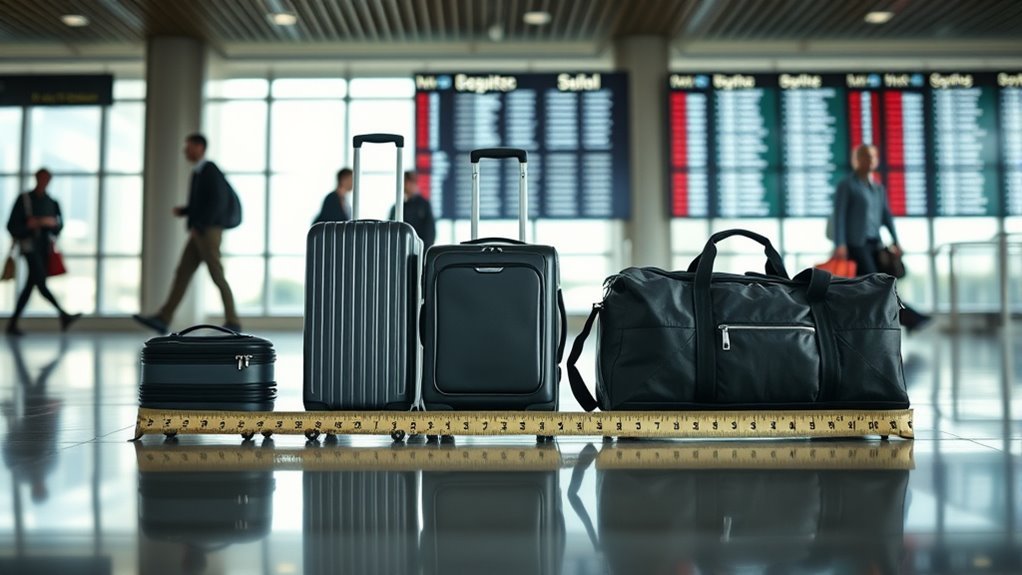
Although airline rules vary, most carriers accept carry-ons about 22 x 14 x 9 inches (56 x 36 x 23 cm), including wheels and handles. Many low-cost or regional airlines enforce smaller limits or stricter weight rules, so always check your specific carrier before you pack.
Most airlines allow carry-ons around 22 x 14 x 9 inches; budget and regional carriers often have smaller or stricter limits.
You’ll typically find that full‑service international and domestic airlines follow that guideline, while budget carriers list smaller size allowances or weight caps.
Some airlines treat personal items separately, letting you bring a small bag in addition to a carry-on.
Exceptions include regional jets with limited bin space and older aircraft with tighter dimensions.
Why Carry-On Size Matters for Your Trip (Fees, Boarding, Packing)
The size of your carry-on can directly affect whether you pay extra fees, so it’s worth checking your airline’s limits before you pack.
If your bag fits the allowance, you’ll board faster and avoid gate-check hassles.
Packing smart to meet size rules also keeps essentials within reach and saves time at the carousel.
Airline Fee Impact
Because airlines set specific size limits and strict carry-on rules, what you pack and the bag you choose can directly affect your trip’s cost and convenience.
If your bag exceeds limits, you’ll often pay gate or checked-baggage fees that can be steep and unexpected. Some carriers charge for larger personal items too, so choosing a compliant bag saves money.
Frequent flyers can avoid fees by knowing each airline’s dimensions and weight allowances before booking. Budget carriers enforce rules rigorously; legacy airlines may be more lenient but still charge for oversized items.
Smart sizing helps you dodge extra charges and last-minute hassles.
Boarding & Packing
Want to breeze through boarding and avoid surprise fees? You’ll move faster when your bag fits the sizer and stows overhead without drama. Packing smart keeps essentials reachable, avoids gate check stress, and saves money.
| Feeling | Result |
|---|---|
| Calm | Smooth boarding |
| Confident | No gate fights |
| Prepared | Essentials at hand |
| Frugal | Avoided fees |
| Proud | Travel savvy |
Choose a compact, organized bag, weigh it before leaving, and pack a slim personal item. You’ll skip last‑minute shuffling, protect valuables, and enjoy more travel control.
How Airlines Define Carry-On vs Personal Item
You’ll want to know the specific carry-on size limits each airline enforces so your bag fits the overhead bin.
Also check what counts as a personal item—usually a smaller bag that must fit under the seat—and how strict those criteria are.
Finally, learn when airlines will gate-check oversized or full carry-ons to avoid surprises at boarding.
Carry-On Size Limits
How big is a carry-on, and how does it differ from a personal item? Airlines set carry-on size limits by maximum linear dimensions (length + width + height) or specific measurements, often around 22 x 14 x 9 inches for U.S. legacy carriers.
Low-cost and international airlines vary—some allow smaller bags, others slightly larger. Weight limits may apply, commonly 7–10 kg on many carriers.
You should check your airline’s website before packing, since gate agents enforce rules inconsistently. If your bag exceeds limits, you’ll likely gate-check it or pay an oversize fee, so measure and weigh to avoid surprises.
Personal Item Criteria
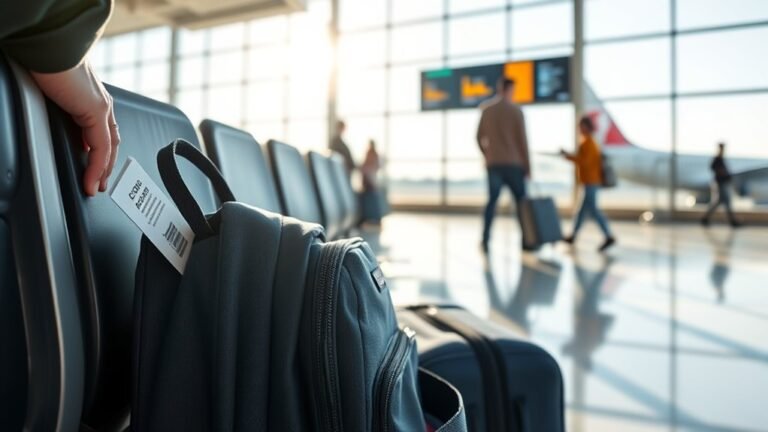
While carry-ons get most of the attention, airlines also define a “personal item” that you’re expected to stow under the seat in front of you—think laptop bags, purses, or small backpacks.
You should know dimensions vary by carrier; common limits hover around 18 x 14 x 8 inches but check your airline.
Personal items must fit under the seat, not in overhead bins, and are meant for essentials you’ll need onboard.
Pack compactly: laptop, documents, medication, a small toiletry kit.
Don’t confuse weight rules—some carriers enforce them.
Confirm allowed items and dimensions before you travel to avoid surprises.
Gate-Checked Exceptions
1 common exception you’ll encounter at the gate is that agents will reclassify an oversized personal item or an unusually shaped bag as gate-checked, even if it technically meets carry-on limits. You should expect this when overhead bins are full, time’s tight, or boarding priorities force stricter enforcement.
If told to gate-check, stay polite, retrieve essentials, and confirm where and when you’ll get the bag at arrival. Some airlines won’t charge for gate-checking; others might. Knowing airline policy and packing a compact backup with valuables avoids surprises.
Gate-checking is a practical, if inconvenient, compromise to ensure timely boarding.
Standard International Carry-On Dimensions
Because airlines around the world set their own limits, you should check dimensions before you pack. International standards often center on roughly 56 x 45 x 25 cm (including handles/wheels), but variations exist by region and carrier. Measure your bag and confirm with your airline to avoid gate check fees or repacking. Typical smaller regional jets enforce tighter rules; long-haul carriers may allow slightly larger items or an extra personal bag. Use the table below to compare common guideline ranges and remember to weigh checked weight limits separately.
| Region | Typical Size (cm) | Notes |
|---|---|---|
| Europe | 55×40×23 | Common limit |
| Asia | 56×36×23 | Varies by carrier |
| Middle East | 50×40×25 | Often stricter |
| Global long-haul | 56×45×25 | More generous |
Typical U.S. Domestic Carry-On Limits
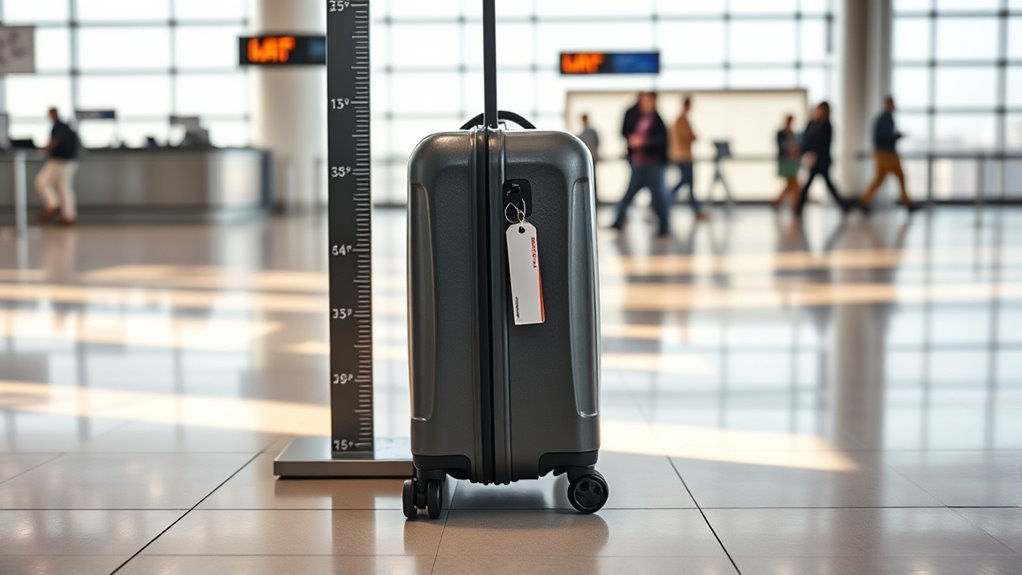
In the U.S., most airlines let you bring a carry-on around 22 x 14 x 9 inches (including wheels and handles), so you should measure your bag before you travel.
Know that some carriers—especially low-cost or regional airlines—have stricter limits or weight rules that can affect what you can bring onboard.
Check your airline’s specific policy to avoid surprises at the gate.
Standard Size Limits
When you fly within the U.S., most airlines set carry-on size limits around 22 x 14 x 9 inches (including wheels and handles), a practical maximum that fits most overhead bins. Smaller regional jets and some low-cost carriers may require slightly smaller dimensions.
You should measure luggage including protruding parts and compare to airline published limits.
Weight limits are less common for carry-ons but can apply on some carriers.
Soft-sided bags can squeeze into tight spaces more easily than hard-shells.
If your bag meets the standard dimensions, you’ll usually avoid gate checks, but always confirm limits before travel to prevent surprises.
Airline Exceptions
Although most major U.S. carriers stick close to the 22 x 14 x 9-inch guideline, airlines often carve out exceptions—so you should always check each airline’s specific limits before you pack.
Some low-cost carriers let smaller personal items aboard but strictly enforce carry-on size and may charge for larger bags.
Regional jets frequently have tighter overhead space, so your suitcase that’s fine on a mainline flight might be gate-checked.
Elite status, military travel, and certain credit-card perks can grant leniency.
Also note that stroller, medical equipment, and musical instrument policies vary, so verify allowances to avoid fees or delays.
Weight Limits vs Size Limits: What’s Enforced
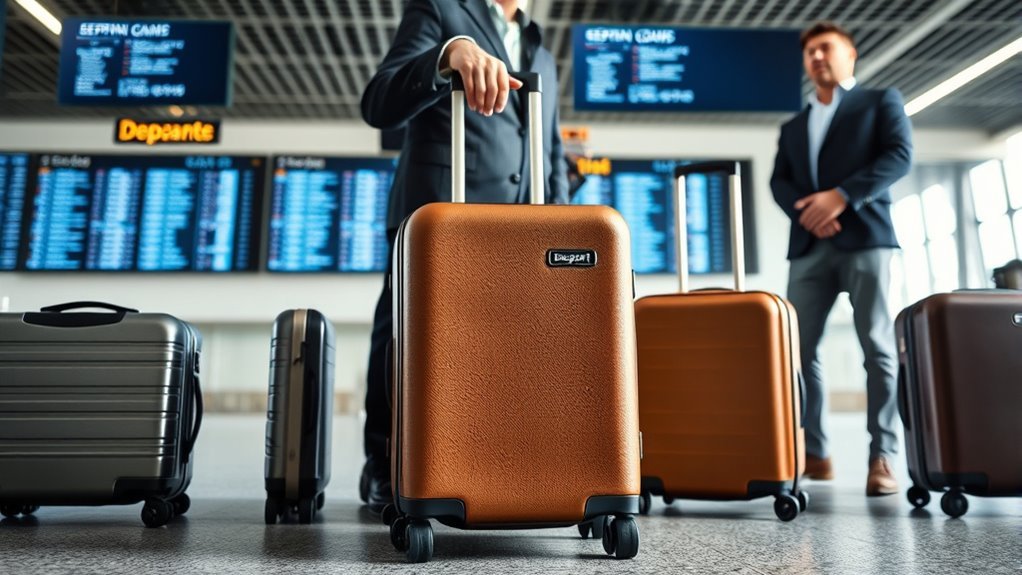
Because airlines check both weight and dimensions, you can’t assume one matters more than the other; carriers enforce whichever rule matters most for cabin safety and space.
You’ll find some airlines strictly enforce weight—especially regional jets with limited overhead bins—and others focus on dimensions to ensure stowage.
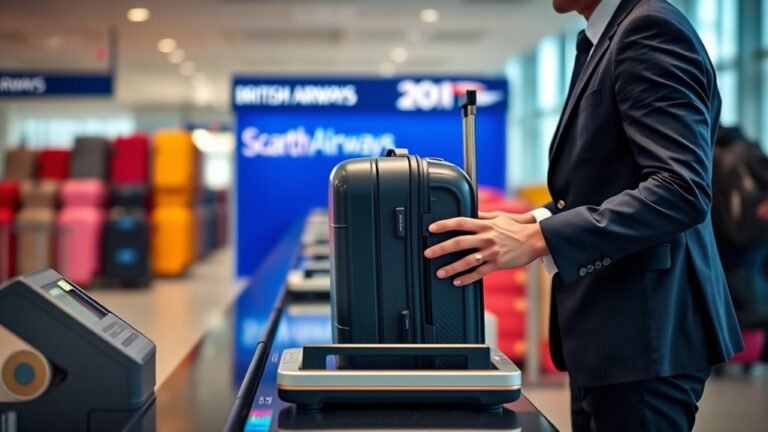
Gate agents may weigh luggage or test-fit it in sizers; if your bag violates either limit, you’ll be asked to gate-check, pay a fee, or redistribute contents.
Check your carrier’s policy before travel, pack to both limits when possible, and be prepared to adjust at the gate to avoid delays or charges.
How to Measure Your Carry-On Correctly
If you want your bag to sail through gate checks, measure it the way airlines do: include wheels, handles and exterior pockets, and measure height × width × depth at their fullest points.
Lay the bag on a flat surface, extend telescoping handles fully, and press any expandable zippers to their closed position when checking standard limits.
Use a rigid tape measure and record each dimension to the nearest half inch or centimeter.
Compare dimensions to your airline’s published maximums, not third-party guides.
If you’re close to limits, choose a smaller bag or remove nonessential attachments before heading to the airport.
Why Depth Matters: Under-Seat Fit and Dimensions
You’ll want to check under-seat clearance before you pack, because depth determines whether your bag slides neatly under the seat or gets bumped into the aisle.
A deeper bag can hold more, but it may prevent the seat in front from reclining or block your feet.
Think regarding usable capacity—not just external dimensions—so you get the most in a bag that actually fits under the seat.
Under-Seat Clearance
Wondering why depth matters so much for carry-on bags? You need under-seat clearance to stash essentials, access devices, and keep knees roomier. Measure the airline’s seat voids and compare to your bag’s depth before you fly. If it’s too deep, you’ll gate-check or jam it, wasting time and risking damage.
- Check seat model and row for variable space
- Aim for slim-profile packing to slide under seats
- Test with laptop sleeve and toiletries arranged front-first
- Prefer soft-sided bags that compress slightly
- Remember wheel housings and handles add hidden depth
Depth vs Capacity
Because under-seat space is usually shallow and irregular, bag depth often dictates whether your carry-on lives under the seat or gets gate-checked. You’ll want a shallow profile to slide under varied seats, especially on domestic jets and older aircraft with limited clearance.
Depth affects usable capacity more than width or height; a deeper bag may look roomy but won’t fit when the seat pocket or support bar intrudes. Choose expandable models cautiously—they add volume but can prevent under-seat stowage.
Measure cabin seat depth when possible and prioritize slim, well-organized luggage so you won’t be forced to gate-check.
Wheels, Handles, and Measured Dimensions Explained
Wheels and handles do more than make carry-on luggage easier to move — they change how airlines measure allowed size and how you’ll fit your bag into overhead bins. You should measure height including wheels and extended handles, since carriers often enforce total external dimensions.
Retractable handles should be collapsed when checking size at the gate.
Spinner wheels add width and depth; recessed wheels save space.
Hard-shell cases may bulge, affecting fit.
Know your bag’s packed dimensions, not just advertised interior capacity.
- Measure with wheels and handles extended and retracted
- Include wheel housings in width/depth
- Collapse handles for gate checks
- Check hard-shell bulge
- Compare packed vs advertised size
Major U.S. Airlines: Carry-On Size at a Glance
You’ll find most major U.S. airlines use a similar standard size limit for carry-ons, but the exact inch limits and weight allowances can vary.
Regional carriers and basic economy fares often have stricter rules or different interpretations of “personal item.”
Keep a tape measure handy and check your airline’s policy before you pack to avoid surprises.
Standard Size Limits
When you’re planning a trip, knowing the standard carry-on size limits for major U.S. airlines saves time and prevents surprises at the gate. Carriers generally cap dimensions around 22 x 14 x 9 inches (including handles and wheels), but exact allowances and enforcement vary by airline and aircraft.
You should measure your bag fully and compare it to your carrier’s published limits before flying. If you’re near the maximum, expect closer scrutiny on crowded flights. Pack strategically to avoid gate-checking.
Check weight rules too, since some airlines combine size and weight enforcement.
- Measure height, width, depth including protrusions
- Confirm airline policy online before travel
- Consider soft-sided bags for slight flexibility
- Avoid overpacking to stay under limits
- Keep essentials in a personal item to reduce carry-on size
Regional Rule Variations
Curious how carry-on limits differ across U.S. carriers? You’ll find slight but important variations. Major airlines set a common baseline—about 22 x 14 x 9 inches—but some measure total linear dimensions, others enforce strict width/height/depth.
Regional or budget carriers may limit you to smaller bags or count personal items differently. Weight limits are rare in the U.S., yet specific planes or routes can impose tighter rules.
Gate checks happen if overhead bins fill; some airlines are stricter about that. Always check the carrier’s published dimensions before packing so you know what to expect.
Tips For Compliance
Now that you know carriers vary on dimensions and enforcement, here are clear, practical tips to help you comply with major U.S. airlines’ carry-on rules. You’ll avoid fees and delays by planning: measure your bag, weigh it, and choose flexible luggage that fits overhead bins. Gate agents vary—be prepared to gate-check if needed. Pack essentials in a personal item you can stow under the seat. Review your airline’s current policy before travel and check for gate announcements.
- Measure length, width, height including wheels
- Use a luggage scale before leaving home
- Pick soft-sided bags for tight spaces
- Keep liquids in approved sizes
- Reconfirm rules when booking
Popular International Carriers: Size Rules Summary
Although airlines each set their own limits, you’ll find most international carriers stick to similar carry-on dimensions and weight ranges, so you can plan travel with a few common standards in mind. You should check specifics, but many permit around 55 x 40 x 20 cm and 7–10 kg. Below is a quick comparison to guide packing:
| Carrier Type | Typical Size | Typical Weight |
|---|---|---|
| Full-service Intl | 55x40x20 cm | 7–10 kg |
| Regional/Flag | 55x40x23 cm | 8–10 kg |
| Premium cabins | Same size | Often 10–12 kg |
Confirm rules before you fly.
Low-Cost Airlines: Stricter Carry-On Limits Explained
When you fly with low-cost airlines, they often enforce strict size limits for carry-ons and will measure bags at the gate.
If your bag exceeds the allowed dimensions, you’ll usually be charged a carry-on fee or forced to check it.
Know the exact size and fee policy before you pack to avoid surprises and extra costs.
Strict Size Enforcement
Because low-cost carriers squeeze every dollar out of a flight, they also enforce carry-on size limits more strictly than legacy airlines, and you’ll feel the difference at the gate. You’ll be measured, your bag might be denied boarding overhead, and you’ll need backup plans when staff won’t bend rules. Prepare to act fast and avoid surprises.
- Bring a compliant bag and know its dimensions.
- Pack essentials in a personal item that fits under the seat.
- Weigh and measure at home to prevent last-minute repacking.
- Have a folding tote or compressible option ready.
- Know gate staff won’t usually negotiate.
Carry-On Fees Explained
Gate checks and strict size checks often push travelers into paying extra, so it helps to understand how carry-on fees work on low-cost carriers. You’ll see basic fares exclude cabin bags, charge for larger cabin items, and apply varying fees at booking, online check-in, or gate. Know limits, prepay to save, and pack smart to avoid surprises.
| When | Typical fee |
|---|---|
| Booking | $10–$40 |
| Online check-in | $15–$50 |
| At gate | $30–$100 |
| Oversize item | $50–$150 |
Check airline policy, measure bags, and choose fare intentionally.
Budget Carrier Fees for Oversized Carry-Ons
If your carry-on is even slightly larger than a budget airline’s limit, you’ll usually face a clear, non-negotiable fee at check-in or the gate. You’ll want to measure and compare before you travel, because these carriers charge fixed sums that rise closer to departure. They rarely waive oversize charges, even for frequent flyers, so planning saves money.
Expect different rules between online check-in and boarding gate enforcement.
- Fees often double or increase at the gate versus online
- Some airlines charge per segment rather than per trip
- Payment methods may be limited at kiosks
- No refunds for voluntary gate checks
- Fees apply to dimensions, not just weight
How to Check an Airline’s Exact Policy Fast
When you need a quick answer, go straight to the airline’s official sources: their baggage policy page, the FAQ, and the mobile app will state exact carry-on size limits, fees, and enforcement practices.
Check size in linear dimensions (height×width×depth) and weight if listed. Note exceptions for priority or basic fares.
Use the carrier’s search or site map for “baggage” to avoid outdated pages.
If you booked by phone or through an OTA, open your reservation on the airline site to see rules tied to your fare.
When in doubt, call the airline for a definitive ruling before you travel.
Codeshares and Partner Segments: Whose Rule Applies?
Because codeshare and partner itineraries mix carriers, you’ll usually follow the rules of the operating airline for carry-on size and weight, not the marketing carrier that sold your ticket. Check your boarding pass or confirmation for the operating carrier code, then verify that carrier’s limits. If segments change, rules can change mid-trip, so verify before each flight.
When contacting airlines, ask specifically about the operating flight segment. Keep receipts for checked exceptions or upgrades that affect allowance.
- Check boarding pass carrier code first
- Review operating carrier website limits
- Confirm baggage on each segment
- Ask agents about exceptions
- Keep proof of paid allowances
Connecting Flights and Carry-On Rules
Although you’ll most often follow the operating carrier’s carry-on rules, connecting flights can introduce different size and weight limits mid-journey, so check each segment before you board. You’ll want to verify each carrier’s dimensions, weight allowances, and overhead space, especially on regional or low-cost legs. If limits differ, prioritize the strictest rule or gate-check larger items. Pack flexible, compressible bags and know transfer airport policies to avoid surprises.
| Segment | Typical Limit | Action |
|---|---|---|
| International long-haul | Larger | Follow operating carrier |
| Regional | Smaller | Compact bag |
| Low-cost | Strict | Gate-check |
| Codeshare | Varies | Confirm |
Airline Alliances: Baggage Policies That Carry Over
When you fly with partner airlines in the same alliance, you’ll often see common carry-on size standards that simplify packing.
You should also check interline baggage allowances, since connecting carriers may honor a single allowance or apply the most restrictive rule.
Knowing both helps you avoid surprises at boarding or baggage claim.
Alliance-Wide Size Standards
Ever wondered whether your carry-on rules change when you fly with partner airlines? You’ll often find alliance-wide size standards that simplify expectations: partners agree on maximum dimensions so your bag fits overhead across members. You should still check specifics—exceptions and cabin-class differences exist—but alliances aim to reduce surprises.
Know that standards focus on length, width, depth and sometimes weight, and they usually reflect the strictest member. If you travel frequently, pick a carry-on that meets common alliance limits to avoid gate checks.
- Maximum linear dimensions (L+W+H)
- Per-piece vs. combined size rules
- Cabin-class variances
- Regional exceptions
- Enforcement practices
Interline Baggage Allowances
Curious how your carry-on and checked baggage rules behave across connecting flights with different carriers? When you book itineraries involving multiple airlines, interline baggage allowances determine which rules apply.
Typically the most restrictive carrier’s size and weight limits govern your whole trip, but ticketing carrier or alliance agreements can override this. Always check your ticket and the operating carrier’s policy; airlines often list final allowance on boarding passes.
If limits differ, request confirmation at check-in and get written notes for exceptions. Knowing this prevents surprises and fees, and helps you pack within the effective allowance for your full journey.
Frequent Flyer Status and Extra Carry-On Allowance
Although airlines set standard carry-on dimensions, your frequent flyer status can change what you’re allowed to bring on board. If you’ve earned elite tiers, you’ll often get perks like an extra bag allowance, priority boarding that helps secure overhead space, or relaxed size enforcement.
Benefits vary by airline and sometimes by route, so check your carrier’s rules before you pack. Use loyalty portals or customer service to confirm allowances and any weight limits that apply.
Rules differ by airline and route—verify allowances and weight limits through your loyalty portal or customer service.
- Elite tiers may allow a second carry-on
- Priority boarding improves overhead availability
- Co-branded cards can add carry-on perks
- Family status sometimes extends allowances
- Airline discretion affects enforcement
When Gate Agents Will Force-Check Your Bag
Even with elite perks, gate agents can still make you check a bag if space, safety, or rules demand it. You’ll be asked to gate-check when overhead bins are full, flights are oversold, or your bag visibly exceeds size limits. Hazardous items, obstructive handles, or soft-sided luggage that blocks aisles also trigger checks. Know airline policies and arrive early so agents can stash items before boarding rush. Below is a quick reference to common triggers and outcomes.
| Trigger | Likely Outcome | Tip |
|---|---|---|
| Full bins | Gate-checked | Arrive early |
| Oversold flight | Gate-checked | Be flexible |
| Unsafe item | Denied/checked | Pack safely |
| Oversized | Gate-checked | Measure ahead |
How to Dispute an Oversized Bag Fee
If an airline tags your bag as oversized and charges you, don’t just pay without question—you can dispute the fee. First, stay calm and politely ask the agent to explain measurements and policy. Take photos of your bag next to the airline’s measuring device and note agent names and times. Keep receipts and boarding pass.
- Request a supervisor and calmly present evidence.
- Ask for a written citation or measurement printout.
- File a formal complaint with the airline online within their timeframe.
- Escalate to regulatory bodies if unresolved.
- Use credit card chargeback as a last resort.
Personal Items vs Carry-On: Size & Placement Tips
When you pack, know that airlines treat your carry-on and personal item differently: the carry-on is meant for a small suitcase that fits in the overhead bin, while the personal item—like a backpack, laptop bag, or tote—should slide under the seat in front of you.
Measure both items before you fly and check your carrier’s size limits.
Put heavy, infrequently needed items in the overhead suitcase and essentials—documents, electronics, medications—in the personal item for quick access.
Compress clothes to save space, use clear organization to avoid digging, and board early to secure overhead space if you need it.
Small Backpacks vs Totes: Which Counts as a Personal Item?
Wondering whether your small backpack or tote will count as a personal item? You’ll usually be fine if it fits under the seat in front of you and meets the airline’s dimensions.
Choose based on organization and comfort: backpacks free your hands; totes offer quick access. When deciding, consider these factors:
- Under-seat dimensions and airline policies vary by carrier.
- Weight limits and security screening ease can differ.
- Bag shape matters: rigid bases may ride awkwardly under seats.
- Packing strategy: essentials should be reachable without unpacking carry-on.
- Gate-check likelihood increases with oversized or overstuffed personal items.
Carry-On Allowances for Families and Infants
Traveling with kids means you’ll want to check each airline’s infant carry-on limits so you know what’s allowed for diaper bags and small luggage. You’ll also need to understand stroller and car seat policies—many airlines let you gate-check them or bring them on board for infants.
Finally, see if an extra bag for essentials is permitted so you don’t have to cram everything into your single carry-on.
Infant Carry-On Limits
How many extra bags can you bring for an infant on board? You’ll usually get at least one personal item free for infant essentials, but policies differ by airline and fare class. Check rules before travel so you won’t be surprised at the gate.
Pack smart, prioritize feeds, diapers, and a change of clothes, and know weight or size limits that might apply.
- Most airlines allow one diaper bag in addition to your carry-on
- Some carriers grant a stroller or car seat allowance (check policy)
- Lap infants may not get a separate seat allowance
- Loyalty status can affect allowances
- International rules vary significantly
Stroller And Car Seat Policies
Airlines handle strollers and car seats differently, so check your carrier’s specific rules before you pack or head to the gate.
You can usually gate-check bulky strollers free of charge; collapsible models that fit overhead may be allowed as carry-on items if they meet size limits.
Car seats approved for aircraft use can often be installed in a purchased passenger seat, while non-approved models must be checked.
Bring labels or tags provided at check-in and a protective bag for checked gear.
Arrive early, confirm the airline’s infant and family policies, and ask staff about boarding priority and handling procedures.
Extra Bag For Essentials
If you’ll be flying with a child, you can often bring one extra small bag for diapering and feeding needs in addition to your standard carry-on and personal item—check your carrier’s rules since allowances vary.
You’ll want that extra bag packed efficiently: prioritize diapers, wipes, a change of clothes, and feeding supplies. Keep liquids within limits and separate medications. Label items for quick access during security and gate changes.
Be mindful of weight even if size is permitted, since lifting a child plus bags gets tiring.
- Diapers and disposal bags
- Travel-sized formula or breast pump parts
- Extra outfit
- Sanitary wipes and hand sanitizer
- Essential medications and documents
Pet Carriers and In-Cabin Pet Size Limits
When you plan to travel with a pet in-cabin, the carrier’s dimensions and construction matter as much as your ticket class. You’ll need a soft-sided carrier that fits under the seat and meets airline-specific size limits—typically around 18 x 11 x 11 inches but varying by carrier.
Measure height with your pet standing comfortably. Straps, ventilation, and secure closures matter for safety and containment.
Airlines often limit pets by combined carrier-plus-pet weight and may require the animal to remain inside during boarding and flight. Always check the airline’s current policy before you pack to avoid surprises at the gate.
Medical Equipment and Prescription Exceptions
Need to bring medical gear? You can carry essential medical devices and prescriptions on board, often exempt from size limits, but you should check airline and TSA policies ahead.
Keep documentation, label medications, and pack accessories to fit your carry-on or a secondary personal item.
Keep documentation, clearly label meds, and pack accessories to fit your carry-on or a secondary personal item.
- Bring prescriptions and a doctor’s note for injectable meds
- Notify the airline if you need oxygen or large devices
- Pack batteries separately and follow battery rules
- Keep needles and sharps in approved containers
- Screen medications and devices at security; declare them proactively
Confirm specifics with your carrier before travel.
Carry-On Rules for Sports Equipment and Instruments
You’ll want to check size limits for sports gear like skis, bats, and golf bags since airlines vary on what they’ll accept as carry-on.
Musical instruments often have separate policies and may need a purchased seat or a compact case that fits the overhead bin.
Pack instruments and gear in sturdy, well-padded cases and know the airline’s rules beforehand to avoid surprises at the gate.
Sports Gear Size Limits
Although airlines vary, most set stricter size and handling rules for sports gear and musical instruments than for standard carry-ons, so check policies before you pack.
You’ll find size limits depend on gear type, airline, and cabin space; oversized items often need gate-checked or freight arrangements. Measure length, width, and depth, and consider padded cases to protect equipment. Know weight caps and liability rules; some carriers charge fees or require advance notice.
- Skis/snowboards: often exceed carry-on dimensions
- Golf bags: usually gate-checked
- Bicycles: may require disassembly and box
- Surfboards: size-restricted, often fee-based
- Hockey sticks: may be allowed if within length limits
Instrument Carry-On Policies
When traveling with an instrument, check your airline’s carry-on policy before you pack, because rules vary by carrier and cabin space. You’ll find some airlines allow small instruments as carry-ons if they fit the overhead or under-seat; others require a paid seat or gate-checked handling. Always call ahead, measure your case, and confirm weight limits. Be aware of surge or full flights—gate agents make final decisions. Consider soft cases vs. hard cases for acceptance differences, but don’t discuss packing methods here.
| Airline | Typical Policy |
|---|---|
| Carrier A | Overhead if fits |
| Carrier B | Paid seat required |
Packing And Protection Tips
If you’re carrying sports gear or an instrument onboard, pack with protection and accessibility in mind so items survive handling and gate decisions. You’ll want padding, sturdy cases, and clear labeling; pack fragile components between soft clothing, secure loose parts, and keep batteries or sprays checked or compliant.
Gate-check only when necessary and know airline size rules to avoid surprises. Carry tools and tuners in your cabin bag, and be ready to demonstrate functionality if asked. Follow carry-on limits to prevent forced gate check.
- Use a hard case or reinforced gig bag
- Wrap delicate ends with foam
- Remove or secure detachable parts
- Place soft items around gear edges
- Keep documentation and serial numbers with you
Checked Carry-On Exceptions on International Routes
Because international routes often have different rules, you should check your carrier’s policy on checked carry-on exceptions before you fly. Airlines, customs, and partner carriers may allow oversized items, sports gear, or musical instruments as checked carry-ons with specific fees or advance notice.
You’ll want to confirm size, weight, and packing requirements, plus whether you must declare restricted items. Codeshare flights can follow the operating carrier’s limits, so verify both carriers.
Keep receipts and tagging documentation for transfers. If you need an exception, request it early to avoid gate issues, extra charges, or denied boarding of your bag.
Business and Premium Cabins: Extra Carry-On Perks
If you fly business or premium cabins, you’ll often get extra carry-on allowances that let you bring an additional bag or larger item.
You’ll also get priority boarding, so you can stow your items before overhead bins fill up.
Many carriers include amenity bags or onboard kits that don’t count toward your allowance, giving you useful extras without sacrificing space.
Extra Carry-On Allowances
While coach passengers usually get a single personal item and one carry-on, flying in business or premium cabins often lets you bring extra bags without surprise fees. You’ll usually be allowed an additional carry-on and sometimes a second personal item, which helps when you need camera gear, a laptop bag, or duty-free purchases.
Check your ticket and airline site for exact limits and weight rules to avoid gate hassles. Expect clearer allowances on long-haul flights and with legacy carriers.
Consider storage space in the cabin; overhead bins fill fast.
- extra carry-on piece
- second personal item
- weight versus size rules
- class- and route-dependent policies
- verify before travel
Priority Boarding Benefits
Wondering how priority boarding helps with extra bags? If you fly business or premium, you often get early boarding that lets you stow multiple carry-ons without scrambling. You’ll step on first, secure overhead space, and avoid gate-checked items.
Staff are more likely to assist with larger cabin items and can tag bags properly when needed. Early boarding reduces crowding, so fragile or oddly shaped carry-ons go in safely.
Remember airlines set explicit extra-carry allowances by fare class, so check limits before you pack. Use priority boarding to protect space and save time loading and unloading at your destination.
Amenity Bag Inclusions
Because business and premium cabins often let you bring extra carry-ons, amenity bags become both a convenience and a strategic item—airlines usually allow a compact amenity bag in addition to your standard personal item and carry-on, so you can keep essentials like toiletries, chargers, and valuables within reach without sacrificing overhead space.
Pack thoughtfully: choose leakproof containers, slim electronics organizers, and travel-size toiletries. Keep valuables and medication separate. Consider weight and collapseability to fit under the seat.
Check airline guidelines for size and prohibited items before boarding.
- Travel toothbrush/toothpaste
- Compact charger/power bank
- Medication/health items
- Earplugs/eye mask
- Small valuables pouch
Packing Light: What Fits in a Standard Carry-On
If you stick to a standard 22 x 14 x 9-inch carry-on, you can realistically pack a three- to five-day wardrobe plus essentials without checking a bag.
Start with versatile clothing: two pairs of pants, three tops, underwear and socks for each day, and a lightweight sweater or jacket.
Add shoes: one pair worn, one in the bag.
Toiletries must follow TSA liquid rules—small containers in a clear bag.
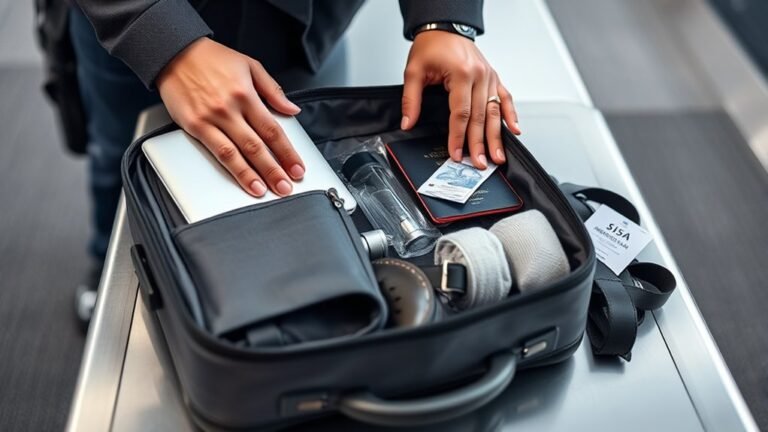
Include chargers, a compact tech organizer, travel documents, meds, and a foldable tote for extra purchases.
Leave bulky items behind to keep weight and space manageable.
Clothes-Packing Hacks to Maximize Space
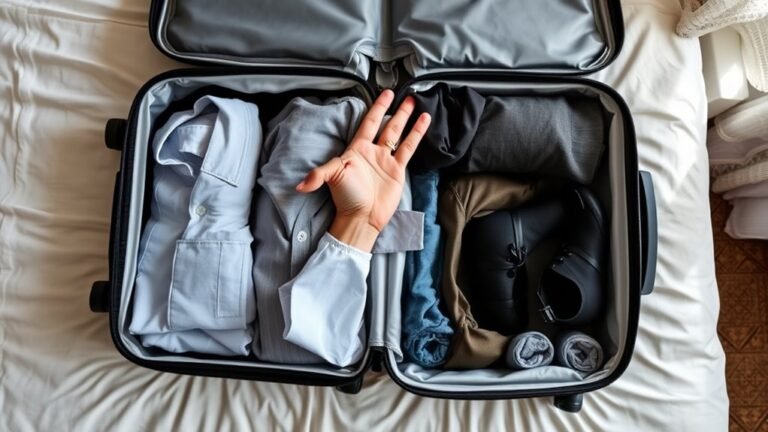
When you’re trying to squeeze a week’s worth of outfits into a 22 x 14 x 9-inch carry-on, smart folding and strategic layering make all the difference. You’ll prioritize versatile pieces, tuck socks into shoes, and use packing cubes to separate outfits.
When squeezing a week into a 22 x 14 x 9 carry-on, pack versatile layers, tuck socks in shoes, and cube outfits.
Compress bulkier items against the suitcase walls and keep daily essentials on top for quick access. Use accessories to fill gaps and choose neutral colors to mix easily.
- Pack lightweight layers that combine for warmth
- Use packing cubes by outfit, not item
- Stuff shoes with small items
- Place heavy items near wheels
- Keep a flat, wrinkle-prone layer on top
Rolling vs Folding: Which Saves Space?
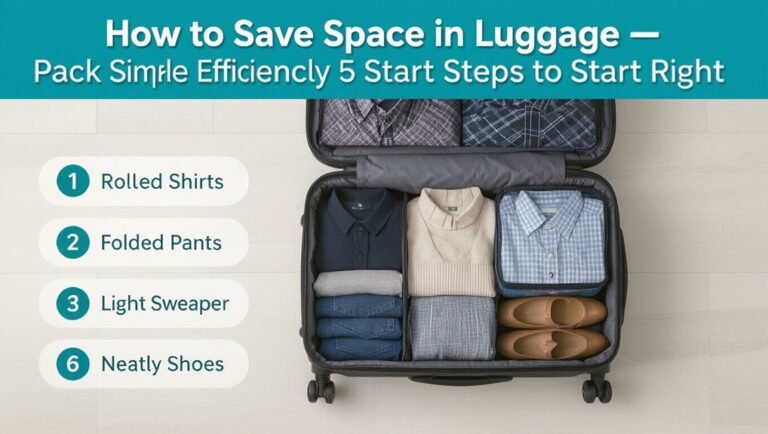
Wondering whether rolling or folding will actually free up more room in your carry-on? You’ll usually save space by rolling soft garments tightly; rolls compress air and fit into gaps. Fold stiffer items to keep shape and avoid wrinkles. Mix methods: roll tees and socks, fold jackets and dress shirts. Layer rolls around folded items to maximize volume. Quick tip: pack outfits so you unpack minimally.
| Rolled | Folded |
|---|---|
| T-shirts | Dress shirts |
| Socks | Jackets |
| Light knitwear | Pants |
| Swimwear | Blazers |
| Gaps filled | Structure kept |
Compression Bags and Organizers: Pros and Cons
Although they add an extra step to packing, compression bags and organizers can dramatically increase usable space and keep things orderly in your carry-on. You’ll fit more without exceeding size limits, protect clothing from dirt, and separate outfits for quick access. They also make security screening easier when items are neatly contained, though bulky or rigid organizers can waste space and slow packing.
Consider durability, weight, and ease of compression before choosing. Use them strategically for bulky items and fragile pieces.
- Saves space with vacuum or roll-down compression
- Keeps outfits organized by day or outfit
- Protects fabrics from spills
- Adds slight weight and bulk
- Might complicate TSA inspection
How to Pack Liquids and Toiletries for Carry-On
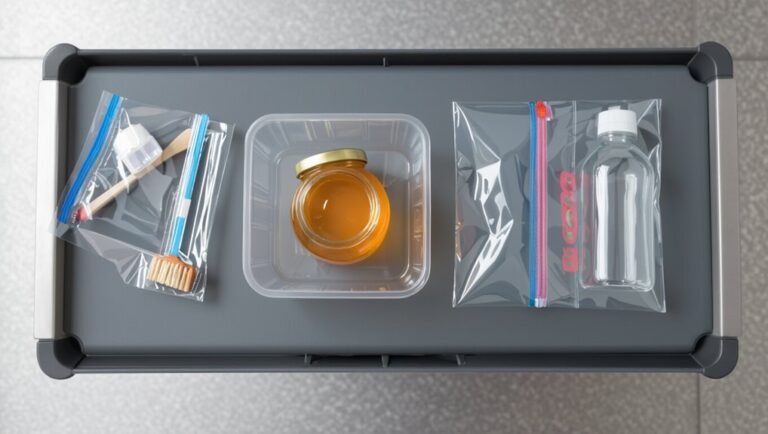
You’ll need to follow TSA liquid rules, which generally limit containers to 3.4 ounces (100 ml).
These containers must fit in a single quart-sized clear bag.
Pack only toiletry essentials and transfer larger products into travel-sized bottles to save space.
Place the clear bag on top of your carry-on for easy screening.
TSA Liquid Rules
How do you pack toiletries so they breeze through TSA screening? You’ll follow the 3-1-1 rule: containers 3.4 oz (100 ml) or less, all fit in one clear quart-sized bag, one bag per passenger. Seal liquids tightly, put heavier items at the bottom, and keep gels, aerosols, creams, and pastes accessible for inspection.
Medications, baby formula, and breast milk are exceptions—declare them.
Avoid full-size bottles and transfer products into travel containers.
- Use a transparent, resealable quart bag
- Label containers if needed
- Check airline-specific rules
- Place the bag on top in your carry-on
- Declare exceptions at security
Packing Toiletry Essentials
When packing toiletries for carry-on, start by gathering only what you’ll need for the trip and transferring liquids into clearly labeled travel-size containers that comply with the 3-1-1 rule.
Place all liquid items in a single, transparent quart-size bag and seal it.
Pack creams, gels, and aerosols upright and pad fragile bottles with cotton or a small cloth to prevent leaks.
Keep medications, contact solutions, and baby essentials accessible for security checks.
Minimize duplicates by using multi-use products and solid alternatives like bar soap, shampoo bars, and solid lotions to save space and avoid spill risks.
Electronics, Chargers, and Battery Rules for Carry-On
Because airlines and TSA treat electronics and batteries differently than other items, you should know the rules before packing your carry-on.
Airlines and TSA handle electronics and batteries differently—know the rules before packing your carry-on.
You’ll need to remove larger electronics for screening, keep spare lithium batteries in carry-on only, and protect devices from damage and accidental activation.
Charge essentials before travel and carry necessary adapters.
- Remove laptops and tablets during security screening.
- Keep power banks and spare batteries in your carry-on, not checked baggage.
- Cover power buttons or use protective cases to prevent accidental turn-on.
- Pack chargers neatly to speed inspection.
- Know airline limits for watt-hours and battery quantity.
What to Leave Out to Avoid Oversized Carry-On
If you want to avoid an oversized carry-on at the gate, leave bulky items that you can easily replace or access at your destination out of your bag—think extra shoes, heavy books, and large toiletry bottles—and instead plan to buy or borrow them when you arrive.
Skip duplicate clothing, bulky jackets (wear layered alternatives), and nonessential hobby gear.
Transfer full-size cosmetics to checked luggage or buy travel sizes.
Leave unnecessary souvenirs or bulky packaging behind.
Digitize documents and media to save space.
Prioritize essentials: travel documents, medications, a change of clothes, and chargers. That keeps your bag compliant and travel stress low.
How to Test Your Packed Bag Before the Airport
After trimming bulky items, you’ll want to verify your bag actually meets size and weight rules before you leave for the airport.
After cutting bulky items, double-check your bag’s size and weight before heading to the airport.
Pack as you intend to travel, zip it, and simulate gate handling: lift by handles, tilt into overhead, and set it on a flat surface.
Measure height, width, depth with a tape against a door or suitcase sizer.
Weigh it on a bathroom scale, subtracting your own weight if you hold it.
Check wheel and pocket bulges; move items to your personal item if needed.
- Measure fully packed dimensions
- Weigh on a reliable scale
- Test lift and carry comfort
- Inspect external bulges
- Rebalance contents if tight
Hard-Shell vs Soft-Shell: Size and Capacity Tradeoffs
When you pick between hard-shell and soft-shell carry-ons, consider how their shapes and materials change usable space and packing behavior.
Hard-shell cases keep a rigid boxy interior that protects fragile items and maximizes external dimensions. But they force you to pack around fixed corners and leave no give for overstuffing.
Soft-shell bags compress into tight spaces and often include exterior pockets for quick access. This lets you squeeze in extra layers or odd-shaped items.
Choose hard-shell if protection and predictable volume matter; pick soft-shell if flexibility and pocketed organization suit your habits.
Match choice to how you pack and travel.
Best Carry-On Sizes for Weekend Trips
Because weekend trips usually mean packing light and moving fast, choosing the right carry-on size makes a big difference in comfort and convenience. You’ll want a bag that fits overhead bins, tucks under seats when needed, and holds essentials without encouraging overpacking. Aim for compact dimensions that match your carrier’s allowances and your travel style.
For quick weekend trips, pick a compact carry-on that fits bins, tucks under seats, and prevents overpacking.
- Choose a 20–22-inch spinner for 2–3 days when you need structure and easy rolling.
- Consider a 18–20-inch soft carry-on for flexible packing and tighter overheads.
- Use a large personal item for shoes and toiletries.
- Prioritize weight and handles.
- Test fit before travel.
Best Carry-On Choices for Long-Haul Flights
Weekend-size bags focus on lightness and quick moves, but long-haul flights demand a different approach: you’ll want carry-ons that balance capacity, comfort, and organization for days in the air.
Choose a soft-sided bag with expandable compartments so you can stash layers, toiletries, and a change of clothes without exceeding cabin limits.
Prioritize padded laptop and tablet pockets, easy-access pockets for documents and snacks, and smooth-rolling wheels for terminals.
Look for durable zippers, a TSA-friendly toiletry pouch, and compression straps to keep items compact.
Consider weight, interior layout, and a comfortable telescoping handle for prolonged handling.
Top-Rated Carry-On Models by Size Category
As you shop, pick a carry-on size that fits your travel style and airline rules—here are top-rated models in compact, standard, and large carry-on categories so you can compare capacity, durability, and features at a glance.
Choose a compact spinner for quick trips, a standard hardside for frequent flyers, or a large expandable for longer escapes.
Look for smooth wheels, strong zippers, and smart pockets. Consider weight limits and warranty.
- Compact: ultra-light 20″ spinner, streamlined interior
- Standard: 22″ hardshell with divider
- Large: 24″ expandable softside
- Hybrid: frame plus soft pockets
- Budget: durable carry-on under $100
How Climate and Trip Length Influence Bag Choice
When you pack for a sun-drenched beach week versus a rainy mountain trek, climate and trip length should drive your carry-on choice. You’ll pick breathable, lightweight fabric and a soft-sided bag for warm destinations to squeeze in swimsuits and sandals.
While waterproof materials and structured compartments work best for wet, cold trips. For short trips, choose a compact roller or backpack with versatile outfits.
For longer stays, bring a slightly larger carry-on with laundry-friendly space and compression options. Consider footwear bulk, layering needs, and accessories—planning by weather and duration keeps you nimble and avoids oversize surprises.
Upgrading at the Gate: When It’s Worth It
If you’re facing a full overhead bin or a last-minute chance to avoid a checked bag fee, upgrading at the gate can be worth it—especially when the upgrade gets you guaranteed cabin space, priority boarding, or a seat with extra legroom. You’ll decide quickly: weigh cost against convenience, boarding stress, and how much you need access to carry-on items.
Ask the agent about baggage policy changes and confirm seating before paying. Consider loyalty status and whether the upgrade includes early overhead access. Be ready to accept a different seat if that’s the trade.
- Confirm total fee and benefits
- Check availability before lines grow
- Prioritize access to essentials
- Factor flight length and sleep needs
- Use status or credit perks when possible
Quick Checklist: Measuring and Packing Before Travel
You’ve decided whether to upgrade at the gate, now make sure your bag actually fits and contains what you’ll need. Measure height, width, depth including wheels and handles; compare to airline limits. Weigh the packed bag on a scale to avoid surprises.
Pack essentials in an accessible top pocket: travel documents, phone, charger, medications, and a light layer. Use packing cubes to compress clothes and keep items organized.
Place liquids in a clear, compliant pouch near the top. Leave a little space for souvenirs or duty-free.
Double-check straps and zippers, then lock or tag your carry-on.
Common Carry-On Myths and Surprising Exceptions
Although airlines publish standard carry-on dimensions, you’ll still run into surprises: gate agents sometimes let slightly oversized bags board, low-cost carriers enforce strict box checks, and international routes can have totally different limits. You should verify rules for each carrier and flight, not assume consistency. Don’t rely on anecdotes or airport folklore; policies change, and staff discretion varies.
Pack smart, know the stages—check-in, gate, and aircraft—and have a backup plan if asked to gate-check.
- Some domestic carriers allow extra carry-ons for elite flyers.
- Budget airlines use hard-size boxes.
- Regional jets have smaller bins.
- Connections can change allowance.
- Military or medical items get exceptions.
Frequently Asked Questions
Are Airlines Stricter About Carry-On Size During Peak Travel Seasons?
Yes — airlines get stricter about carry-on size during peak travel seasons because flights fill up, gate agents enforce limits, and overhead space disappears. You should check policies, weigh bags, and be ready to gate-check if needed.
Can a Carry-On Be Sent to the Aircraft Door if the Overhead Bins Are Full?
Yes — you can usually have your carry-on gate-checked to the aircraft door if overhead bins fill; agents or flight attendants will tag it, you’ll retrieve it at baggage claim, and you won’t need to gate-check early.
Do Ride-Share or Train Baggage Limits Affect Carry-On Choices for Airport Transfers?
Yes — ride-share and train baggage limits can affect your carry-on choices, so check vehicle and carrier size, weight, and luggage count rules, pack compactly, and be ready to gate-check or consolidate items if space’s tight.
Are There Size Allowances for Duty-Free Purchases Added to Carry-On After Security?
Yes, you’ll usually get allowances for duty-free bags beyond your carry-on; many airlines and security checkpoints allow sealed, purchased duty-free items in addition to your normal allowance, but check specific airline and country rules first.
Will TSA or Security Screenings Require Removing Packed Items That Change Bag Fit?
Yes — if packed items change your bag’s fit, TSA or security may require you to remove or repack items to meet size, safety, or X-ray screening rules; you’ll be asked to adjust contents to comply before boarding.
Conclusion
You’ve got the essentials to pick the right carry-on, so you’ll avoid surprise fees and gate hassles. Measure your bag, check your airline’s rules, and choose size based on trip length and climate—plus pack smart with compressible items and a well-organized personal item. If gate upgrades are cheap and you need the space, grab them. With these steps you’ll travel lighter, faster, and with fewer last-minute headaches—ready to board with confidence.