What Makeup Can You Take on a Plane
You can bring most makeup on a plane, but liquids, gels, creams and aerosols must follow TSA’s 3-1-1 rule: containers 3.4 oz (100 ml) or less, all fitting in one clear quart-size bag. Solid products like lipstick, powder, and solid deodorant aren’t restricted. Sharp tools should go in checked bags. Pack multitaskers and travel sizes, keep your quart bag accessible, and use compact brushes for touch-ups—keep going to get a useful checklist and packing tips.
Quick Answer: Carry-On vs Checked Makeup Rules
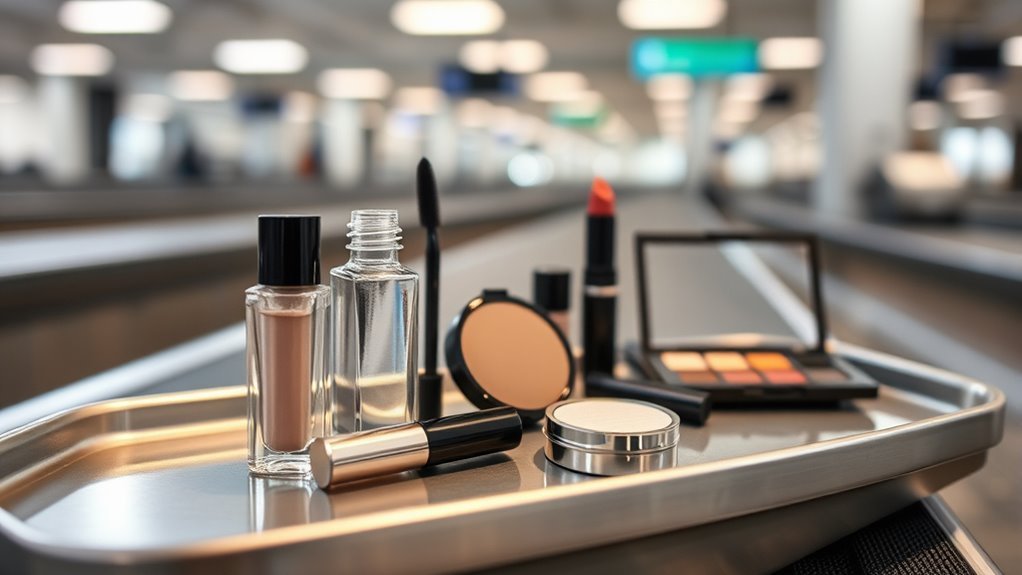
When you pack makeup for a flight, remember that liquids, gels and creams in your carry-on must follow the TSA 3-1-1 rule: each container 3.4 ounces (100 ml) or less, all fit in one clear quart-size bag, one bag per passenger.
You’ll also pack solid cosmetics—powder blush, solid deodorant, lipstick—without liquid restrictions in carry-on or checked bags.
Sharp tools like metal tweezers or scissors with blades longer than 4 inches should go in checked luggage.
High-value items or fragile compacts are safer in carry-on.
If you need extra liquids, place them in checked baggage or buy travel-sized products after security.
How to Use This Guide (Cheat Sheet + Details)
Use the quick cheat sheet to get the essentials at a glance, then check the packing essentials list to make sure nothing’s left behind.
Follow the step-by-step use section for how to organize your bag and handle liquids and tools through security.
Quick Cheat Sheet
Before you skim, note this cheat sheet gives the essentials at a glance and links to the detailed steps below, so you can pack quickly without missing anything important.
Use this list to decide what to keep in your carry-on, what’s TSA-friendly, and what to stash in checked luggage if needed.
Pack travel-sized liquids, solid alternatives (powder blush, cream stick), a minimal eyeshadow trio, tinted SPF, multitasker products, and disposable tools.
Prioritize items that save space and time: dual-use sticks, sealed wipes, and compact brushes.
Follow the linked sections for rules, quantities, and packing techniques.
Packing Essentials
If you want to pack smart, start by matching the cheat sheet’s quick list to the detailed sections so you only bring what you’ll actually use. You’ll prioritize essentials, follow liquid limits, and separate carry-on from checked items. Keep items accessible for security and touch-ups. Use clear pouches, label fragile compacts, and pick multi-use products to save space. Remember TSA rules for liquids and sharp tools; keep receipts for new items if questioned.
| Item | Why it’s useful |
|---|---|
| Tinted moisturizer | Hydrates + evens skin |
| Concealer stick | Spot corrects |
| Mascara (travel) | Defines lashes |
| Lip balm | Prevents dryness |
| Mini brush set | Precision application |
Step-By-Step Use
Now that you’ve got your packing list and know what fits in carry-on vs checked luggage, follow a clear step-by-step routine to get ready for travel touch-ups.
Start by placing liquid items in a quart-size clear bag and keep it accessible for security.
Pack a small pouch with essentials: tinted moisturizer, concealer stick, mini mascara, lip balm, blotting papers, and a compact powder.
At your seat, freshen with blotting paper, apply light concealer to trouble spots, sweep powder to set, curl lashes and add mascara if needed, then finish with balm or tinted gloss.
Store used tools in a zip pouch.
TSA 3-1-1 Rule Explained
You’ll need to follow the TSA 3-1-1 rule when packing liquids for your carry-on, which limits how much you can bring. Make sure each container is 3.4 ounces (100 mL) or smaller and that everything fits in a single quart-sized clear bag.
I’ll also share practical packing tips to speed you through security and avoid tossing your favorite products.
Carry-On Liquids Limit
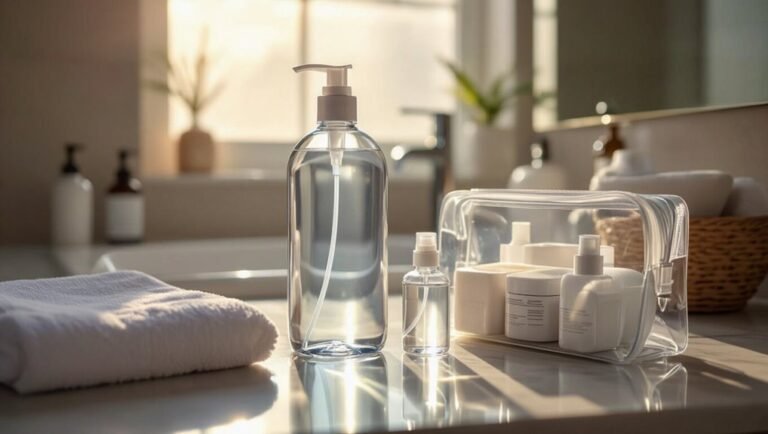
Because cabin security limits what you can bring through checkpoints, the TSA’s 3-1-1 rule determines how much liquid makeup you can carry on a plane: containers of 3.4 ounces (100 milliliters) or less, all fitting into a single clear quart-sized bag, one bag per passenger.
Pack foundation, liquid concealer, mascara, and liquid highlighter in that bag. Separate creams and gels into travel-size jars that meet the limit. Keep the bag accessible for screening and avoid overstuffing.
If you need larger quantities, check your bag or buy replacements after security. Label items if needed to speed inspection.
Allowed Container Sizes
Since those liquid makeup items have to fit through security, the TSA’s 3-1-1 rule sets a clear size limit: each container can’t hold more than 3.4 ounces (100 milliliters). All containers must fit inside one clear quart-sized bag, and each passenger gets only one bag.
You should check product labels—many travel-sized foundations, primers, and sprays are marked 3.4 oz or smaller. Solid cosmetics like stick foundation or powder compacts aren’t counted as liquids, but creams, gels, and liquid liners are.
If you carry backups, rotate them between checked and carry-on luggage to stay compliant and avoid delays at the checkpoint.
Packing Tips For Security
When packing your carry-on, organize all liquids, gels, and creams into a single clear quart-sized bag so security checks go quickly and you don’t risk having to discard items.
Separate mascara, foundation drops, liquid concealer, and travel spray in labeled containers under 3.4 ounces (100 ml). Put the bag where you can easily remove it at screening.
Solid cosmetics like powder blush, lipstick, and cream-to-powder sticks don’t need the bag but keep them accessible.
If you carry a medical cream or baby formula, declare it.
Replace leak-prone caps with tape and use reusable travel bottles to save space and avoid spills.
Which Cosmetics Count as Liquids, Gels, or Aerosols?
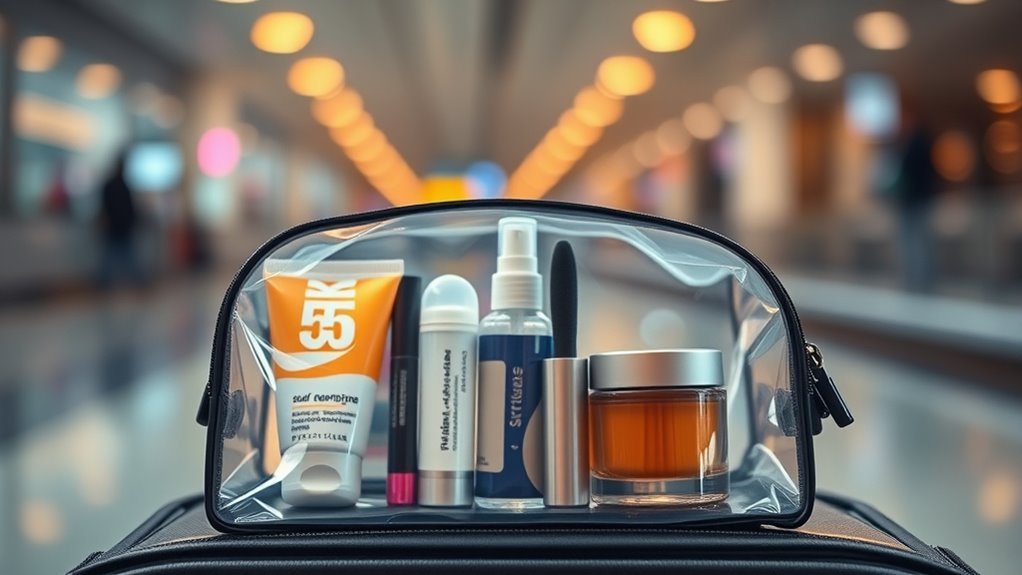
Wondering which of your beauty items count as liquids, gels, or aerosols? Think liquids and gel-like textures: foundation, tinted moisturizers, BB/CC creams, liquid concealers, liquid highlighters, and cream bronzers.
Mascara, liquid eyeliners, lip glosses, liquid lipsticks, lip balms in liquid form, and micellar water fall into the same category.
Sprays and mists—setting spray, thermal water, and hair sprays—are aerosols.
Nail polish, remover liquids, and perfume are included too.
Pack these in travel-size containers and fit them inside a single clear quart bag to meet 3-1-1 rules and speed you through security.
Which Cosmetics Count as Solids and Bypass 3-1-1?
If you prefer to skip the 3-1-1 juggle, pack true solids—stick foundations, powdered bronzers, pressed or loose powders, solid deodorant, bar soap, cream-to-solid balms, and makeup pencils (with the tip exposed)—because TSA treats these differently than liquids and gels.
You can stash them in carry-on without the quart bag constraints, though bulky items may count toward your baggage limit.
Solid mascaras and eyeliner pencils are fine; avoid cream products that melt into a semi-liquid.
Label unfamiliar items if asked, and keep bulky solids accessible for inspection.
When in doubt, choose a solid alternative to simplify security.
Packing Foundation for Carry-On Travel
You’ll need to follow TSA liquid rules when packing liquid or cream foundation in your carry-on, so keep containers 3.4 ounces (100 ml) or smaller and place them in a clear quart bag.
If you prefer a solid option to skip the 3-1-1 limit, bring a cream-to-powder stick or a powder foundation.
For quick application onboard, pack a small sponge or travel brush and a compact mirror to touch up without mess.
TSA Liquid Rules
Although airport security can feel strict, packing foundation for carry-on is straightforward once you know the TSA’s 3-1-1 rule.
You can bring liquids, gels, and aerosols in containers of 3.4 ounces (100 milliliters) or less, all fitting inside one clear quart-sized bag per passenger.
Make sure your liquid foundation, tinted moisturizer, or cream concealer meets that size and is sealed to avoid leaks.
Place the bag where officers can easily access it during screening.
If your foundation exceeds the limit, check it or transfer a travel-sized portion into an approved container to comply and save time.
Foundation Application Tips
Now that you know what size foundation you can bring, focus on how to pack and apply it on the go so it stays fresh and easy to use.
Choose a travel-friendly container: a spill-proof pump or a silicone squeeze tube prevents leaks. Pre-fill a 3.4 oz bottle if needed and label it.
Pack with cotton pads, a small sponge, or a flat brush in a padded pouch to avoid contamination.
For application, dab on cheeks and forehead, then blend outward for even coverage.
Use a blotting sheet or translucent powder to set immediately.
Clean tools after travel to keep skin clear.
Travel Tips for Liquid Concealers and Color Correctors
When packing liquid concealers and color correctors, keep them in clear, leak-proof containers and place them in an easily accessible pouch so you can pull them out during security checks or touch-ups.
Choose travel-sized bottles under 100ml and cap them tightly; wrap lids with tape or store upright to prevent spills.
Use multi-use shades to minimize items and pick color correctors that neutralize specific tones so you don’t overpack.
Bring a slim brush or sponge for precise application and cotton swabs for fixes.
Label containers and pack backups in checked luggage if you’ll need larger quantities on longer trips.
Can You Bring Cream Contour, Blush, and Bronzer on a Plane?
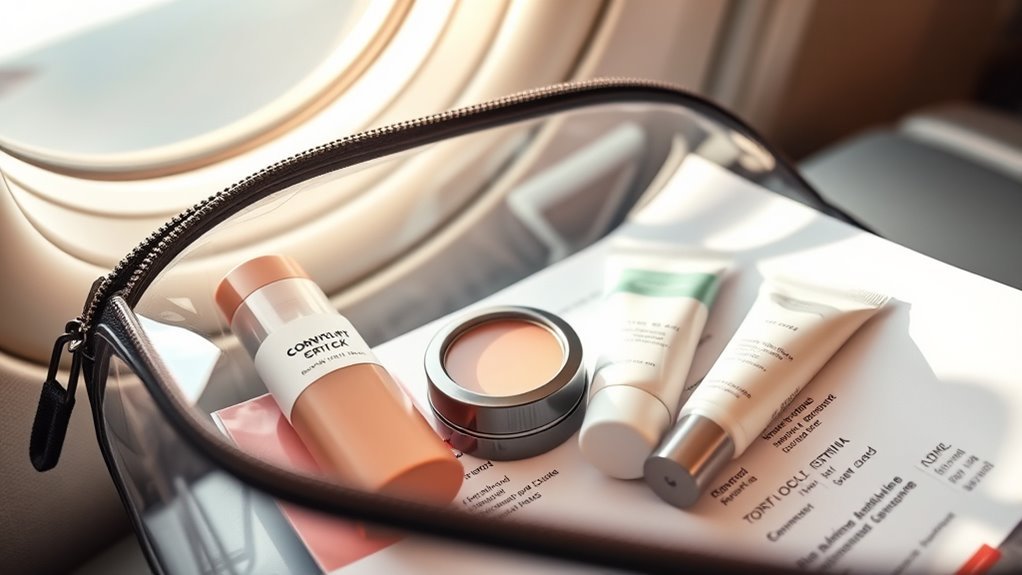
You can bring cream contour, blush, and bronzer in your carry-on, but they’ll count toward the 100 ml/3.4 oz liquid limit if they’re in jars or tubes.
If you want more product or larger pots, tuck them into your checked bag to avoid the size rules.
Pack cream items in leak‑proof containers and a separate quart‑size bag to make TSA screening smoother.
Carry-On Liquid Rules
Because cream contour, blush, and bronzer can blur the line between solids and liquids, you’ll need to follow TSA and airline carry-on liquid rules: containers of liquids, gels, creams, and pastes must be 3.4 ounces (100 mL) or less and fit inside a single clear quart-sized bag.
Larger items should go in checked baggage or be placed in original packaging that clearly shows a smaller size. Check product size before packing.
Transfer creams into travel jars labeled with volume. Limit how many items you include to keep the bag under control.
Declare any medically necessary creams separately at security if asked.
Checked Bag Options
If carry-on limits make packing your cream contour, blush, or bronzer impractical, check your suitcase instead—checked baggage lets you bring full-size jars and compacts without the 3.4-ounce restriction.
You can pack heavier or liquid-based products, but seal containers to prevent leaks; use tape, zip bags, or wrap in clothing. Consider durable packaging to avoid crushed compacts.
Remember airline weight limits and potential fees—overweight bags may cost extra.
For valuable or fragile items, keep backups in your carry-on.
Check destination rules for prohibited ingredients and always label products if they contain liquids to speed inspection.
Packing Powdered Makeup: Eyeshadow, Bronzer, and Setting Powder
When flying with powdered makeup, pack eyeshadows, bronzer, and setting powder in sturdy, cushioned containers to prevent spills and crumbling. You’ll want compact organizers, bubble wrap, or cotton to stabilize pans. Place fragile palettes in the middle of your carry-on, away from heavy items. Label basics for quick security checks and keep a small brush pouch accessible for touchups. Clean lids before packing to avoid staining.
| Item | Protection | Tip |
|---|---|---|
| Eyeshadow palette | Padding, hard case | Store flat |
| Bronzer compact | Bubble wrap | Avoid stacking |
| Setting powder | Zip pouch | Seal tightly |
Mascara & Liquid Eyeliner : Carry-On Limits and Exceptions
Although mascara and liquid eyeliner look small, they generally fall under the TSA’s 3-1-1 liquids rule, so you’ll need to pack them in containers of 3.4 ounces (100 ml) or less and place them in a single clear quart-sized bag with your other liquids.
You should check tubes and pens for size markings; most standard mascaras comply. If you carry multiple liquid eye products, combine them thoughtfully to stay within the quart bag limit.
Exceptions exist for medically necessary liquids and infant formula, but cosmetic liquids don’t qualify. Declare any oversized items at security to avoid delays.
Solid and Gel Eyeliners: What’s Allowed in Carry-On?
You can bring solid eyeliners in your carry-on without worrying about the TSA liquid rules.
While gel liners may count as liquids depending on packaging, know the difference—solid pencils and kohl sticks are treated like regular cosmetics.
Gels in jars or pots over 3.4 ounces need to go in checked baggage or meet the 3.4-ounce bagged limit.
TSA Liquid Rules
If you’re packing eyeliners for carry-on, know the TSA treats solids differently from gels and liquids, so you’ll need to separate gel or liquid eyeliners into your quart-sized bag while solid pencil liners can go straight into your main carry-on.
Follow the 3-1-1 rule: containers 3.4 ounces (100 ml) or less, all fit in one clear quart bag, one bag per passenger.
Label or nest small caps to prevent leaks. Roll bulky items in checked luggage if unsure.
Be ready to remove the quart bag during screening to speed inspection and avoid delays.
- 3.4 oz max per container
- One clear quart bag
- One bag per passenger
- Remove bag for screening
Solid vs Gel Differences
When deciding what to pack, know that solid pencil liners are treated like typical solids and can go in your main carry-on.
While gel or cream liners count as liquids/gels and must fit in your quart-sized 3.4 oz bag. You’ll find solid sticks, kohl pencils, and retractable liners convenient since they don’t need the liquids pouch.
Gel pots, cream liners in jars, and liquid eyeliners fall under the TSA liquid rule, so keep them in the clear bag and within size limits.
Choose solids for simplicity and gels for smoother application, balancing convenience with the looks you want.
Packing Tips For Security
Because airports separate solids from liquids, pack solid pencil liners in your carry-on without the quart-sized bag, but put gel, cream, and liquid eyeliners inside the 3.4 oz clear pouch to meet TSA rules. You’ll move through screening faster if you sort items before packing and label travel pots.
Keep tools accessible for inspection and avoid large jars that’ll be denied.
- Stow pencils uncapped or capped, but don’t sharpen before security.
- Transfer gels into 3.4 oz travel jars, clearly labeled.
- Place eyeliners in a single, transparent pouch.
- Bring receipts or allergy notes for medicated products.
How to Bring False Lashes, Lash Glue, and Lash Kits
Although airlines limit liquids, you can still pack false lashes, lash glue, and full lash kits—just follow a few compact rules.
Keep lashes in their original or a slim hard case to prevent crushing; soft pouches work for short trips.
Keep lashes in their original case or a slim hard shell to avoid crushing; soft pouches suffice for quick trips
Place glue in carry-on only if it’s 3.4 oz (100 ml) or less and inside your quart-size clear bag; otherwise check it.
For TSA-friendly convenience, buy travel-size adhesive or adhesive strips.
Pack tweezers, applicators, and removers in carry-on or checked luggage based on sharp-item rules at your airline.
Label items and stash fragile pieces centrally to avoid damage.
What Lipstick Types You Can Take in Carry-On and Checked Bags
If you’re packing lipstick for a flight, know that solid sticks, balm-style tints, and powder lip colors travel freely in both carry-on and checked bags.
But liquid lip glosses, lip oils, and any product with runny consistency must follow the TSA’s liquids rule (3.4 oz/100 ml inside your quart-size clear bag) if you want them in the cabin.
You should store solids in a small pouch or case to avoid breakage, label liquids clearly, and consider travel-friendly balm pots for touch-ups.
Choose sturdy tubes for checked baggage to prevent melting or crushing.
- Solid bullet lipsticks
- Balm tints and pots
- Powder lip colors
- Lip crayons and stain sticks
Lip Gloss and Liquid Lipstick: 3-1-1 Packing Strategies
Solid lip products are easy to stash, but liquid formulas need a bit more planning when you’re flying. You’ll follow the 3-1-1 rule: place containers 3.4 ounces (100 ml) or smaller into a single, clear quart-sized bag.
Limit liquids, gels, and creams to that one bag, and keep it accessible for security checks. Transfer oversized glosses into compliant sample vials if you want favorites on board. Seal caps tightly and wipe residue to prevent leaks.
Consider travel-sized palettes with gel stains instead of multiple tubes. Pack extras in checked luggage to avoid last-minute removals.
Tips for Carrying Lip Balms, Solids, and Medicated Sticks
You can stash solid lip balms and medicated sticks in your carry-on without worrying about the 3-1-1 liquid rule, since solids aren’t counted as liquids.
If a balm is in a tube but has a liquid serum, treat it like any other liquid and keep it in your quart-sized bag.
For prescription or medicated sticks, pack the original label and any doctor’s note to speed up security checks.
Carry-On Liquid Limits
Because TSA treats lip balms, sunscreen sticks, and medicated salves based on texture, you’ll want to sort them before you pack—liquids and gels in your quart-sized clear bag, and true solids can go in your carry-on outside the bag.
Know the 3-1-1 rule: containers must be 3.4 ounces (100 ml) or less, all fit in one clear quart bag, and one bag per passenger.
Label or test texture at home to avoid surprises. When in doubt, move ambiguous items into the quart bag.
- Check tube volume before travel
- Keep jars under 3.4 oz
- Place creams in clear pouch
- Separate lipsticks
Packing Medicated Sticks
When stashing lip balms, sunscreen sticks, and medicated salves for a flight, sort by texture and tube size so you won’t get held up at security. Put solid sticks and balms in your carry-on; they’re exempt from the 3.4-ounce liquid rule.
Keep medicated salves in original packaging or label them clearly if you transfer them to a smaller tube. If a salve is soft or semi-solid, pack it with other toiletries in a resealable bag to avoid leaks and show agents easily.
For prescriptions, carry a note or prescription. Stash extras in checked luggage for longer trips or backups.
Can You Fly With Perfume and Fragrance Samples?
If you’re packing perfume or fragrance samples for a flight, know that TSA and most international security agencies treat them like other liquids: they must fit the carry-on liquids rules or go in checked baggage.
You can carry small vials (100 ml/3.4 oz or less) in a single clear quart-sized bag, or stow larger bottles in checked luggage. Declare oddly shaped containers if asked.
Consider solid perfumes and atomizers that comply with limits. Protect glass bottles with padding to avoid spills.
Try solid perfumes or compliant atomizers, and cushion glass bottles to prevent spills and breakage.
- Keep bottles under 100 ml for carry-on
- Use a clear resealable bag
- Pad glass containers
- Check oversized perfume bottles
How to Pack Aerosol Hair and Styling Products
Though aerosols make styling quick, they’re regulated as flammable pressurized containers, so you’ll need to pack them thoughtfully.
Carry-on rules generally limit liquids, gels, and aerosols to 100 ml (3.4 oz) in a clear quart-sized bag. Larger cans go in checked baggage if allowed.
Check airline and TSA guidelines for quantity limits and prohibited items.
Secure caps, place cans upright, and cushion them to prevent punctures or accidental discharge.
Consider travel-size non-aerosol alternatives—creams, pomades, or travel spray bottles—to avoid restrictions and reduce risk during transit.
Sunscreen and SPF Makeup: What’s Allowed in Carry-On
You can bring SPF liquids and sprays in your carry-on, but they’ll need to follow the TSA 3-1-1 size limits for liquids.
If your sunscreen or SPF primer is in a tube or bottle larger than 3.4 ounces, pack it in checked luggage or buy a travel-sized version.
For a hassle-free option, consider solid sunscreens or SPF sticks that aren’t subject to liquid restrictions.
SPF Liquids Rule
Wondering whether your SPF moisturizer or sunscreen counts as a liquid in carry-on? You’ll treat most SPF formulas as liquids or gels, so pack them accordingly to avoid surprises at security.
Solid stick sunscreens and powder SPF products usually fly under the liquid rule, but creams, lotions, and sprays are inspected as liquids.
Label and separate your SPF items for screening ease.
- Cream sunscreen and SPF moisturizers are considered liquids
- Spray sunscreens fall under liquid/ aerosol checks
- Solid stick SPFs are generally exempt from liquid classification
- Powder SPF products typically aren’t treated as liquids
TSA Size Limits
When flying, remember most SPF creams, lotions, and sprays in your carry-on must fit the TSA’s 3.4-ounce (100 ml) liquid rule and go inside a single clear quart-sized bag.
Sticks and powders are usually exempt and can be packed separately. Check labels before you pack: sunscreen, BB creams with SPF, and liquid primers count as liquids.
Place travel-size bottles upright and seal leaks with tape or plastic wrap. If you need more sunscreen, buy it after security or stow full-size tubes in checked baggage.
Keep receipts for purchases made post-screening to avoid confusion on return.
Solid Sunscreen Options
After sorting liquids and powders for your carry-on, think about solid sunscreen options that won’t trigger the 3.4-ounce rule. You can pack compact, travel-friendly SPF that’s TSA-friendly and mess-free. Choose balms, sticks, and tinted solid formulas that glide on without leaking.
Look for broad-spectrum protection and check ingredient lists if you have sensitive skin. Keep products under typical size guidelines and place them where you can access them for screening questions.
Solid sunscreens are handy for reapplying during long flights or after airport outings.
- SPF stick balm
- Tinted solid sunscreen compact
- Zinc oxide sunscreen bar
- Travel solid sunscreen sachet
How to Transport Skincare Serums, Creams, and Moisturizers
Because many serums and creams come in glass bottles or bulky tubs, plan ahead to protect them and meet TSA rules for carry-on liquids. Choose travel-size containers (100 ml/3.4 oz or less) and consolidate into clear quart-sized bags.
Transfer serums into sturdy plastic or silicone dropper bottles and decant creams into small, leakproof jars. Cushion glass with clothing or bubble wrap if checked.
Label each container to avoid spills and ingredient confusion. For long trips, bring sealed backups in checked luggage and keep active treatments in carry-on to control temperature.
Check airline and destination restrictions before you pack.
Makeup Removers, Micellar Water, and Cleansing Oils Rules
If you want to carry makeup removers, micellar water, or cleansing oils in your carry-on, stick to TSA liquid limits—containers must be 3.4 oz (100 ml) or smaller and fit in a single clear quart-sized bag.
Carry makeup removers, micellar water, or cleansing oils only in 3.4 oz (100 ml) bottles inside a clear quart-sized bag.
You’ll also want to:
- Choose travel-size bottles or decant into compliant containers to avoid confiscation.
- Label containers clearly and pack them where you can access them during screening.
- Keep wipes or solid bars in checked or carry-on luggage since they’re exempt from liquid rules.
- Declare any larger or unusual products at security; TSA agents decide on a case-by-case basis.
What to Do With Multipurpose Balm Sticks and Solid Cleansers
Those compact balm sticks and solid cleansers won’t count as liquids, so you can often stash them in your carry-on without worrying about the 3.4 oz rule—just make sure they’re in solid form and stored in a clean container or pouch to avoid melting or residue.
Pack them upright if possible to limit contact with other items, and use small tins or reusable sleeves to keep crumbs and oils contained.
Label any homemade bars, and wrap creams set into solid form.
At security, present them if asked; otherwise keep them accessible in case officers want to inspect without delay.
Nail Polish, Remover, and Nail Tools: Carry-On vs Checked
When packing nail polish, remover, and tools, know that rules differ: liquid polish and remover fall under the 3.4 oz (100 ml) carry-on limit and must be in your quart‑size bag, while solid polish strips, files, clippers, and buffers are fine in either carry-on or checked luggage.
Keep liquids sealed and consider spill-proof caps. Put fragile bottles in a padded pouch or wrap them to prevent leaks. If you need acetone, check airline or country restrictions before flying. Pack nail tools thoughtfully to avoid delays at security.
- Place liquids in clear quart bag
- Pad glass polish bottles
- Store remover upright
- Keep strips accessible
Bringing Razors, Tweezers, and Other Sharp Beauty Tools
Because security treats sharp items differently depending on type and location, you’ll want to sort razors, tweezers, and other sharp beauty tools before you pack. You can carry small tweezers and disposable razors in carry-on; safety and electric razors are usually fine too. Straight razors, razor blades, and long cutting tools must go in checked luggage. Labeling or sheathing blades reduces risk. Check your airline’s rules before travel.
| Item | Suggested Placement |
|---|---|
| Tweezers | Carry-on |
| Disposable razors | Carry-on |
| Straight razors/blades | Checked |
| Scissors (>4 in) | Checked |
Electric Beauty Devices & Batteries : TSA Rules
If you’re packing electric beauty devices—like hair dryers, straighteners, epilators, or facial cleansing brushes—know that TSA rules focus on batteries: devices with installed lithium-ion batteries are generally allowed in carry-on, but loose spare batteries must go in your carry-on with terminals protected. Devices with non-removable batteries can usually go in checked bags.
You should remove spare batteries from devices when possible, protect terminals with tape or original packaging, and pack chargers in carry-on. Check airline limits for battery capacity. Follow TSA officer instructions at security to avoid delays.
- Carry-on for spare lithium batteries
- Tape or cap terminals
- Keep chargers handy
- Verify battery mAh limits
How to Travel With Aerosol Deodorants and Solid Sticks
Although aerosol cans and solid sticks both belong in your toiletry kit, they travel under different rules—so pack them smart.
You can carry solid stick deodorants in either your carry-on or checked bag without liquid restrictions.
Aerosol deodorants are allowed, but most must be in checked baggage if they exceed size or contain flammable propellants; check airline and country limits.
For carry-on aerosols under the TSA 3-1-1 rule, guarantee containers are 3.4 ounces (100 ml) or less and fit in your quart-sized bag.
Protect caps, avoid leaks by placing items in a sealed plastic pouch, and label if needed.
Can You Bring Powdered Supplements or Dry Beauty Powders?
When you pack powdered supplements or dry beauty powders, know that their rules differ from liquids: TSA lets most powders in carry-ons but may screen or limit large quantities, and some countries have stricter rules. You should declare powders if asked, keep them accessible for inspection, and avoid overpacking to prevent delays.
Pack supplements in original containers with labels when possible. Consider mailing bulk items ahead for international trips.
- Carry smaller, travel-friendly amounts to ease screening.
- Store powders in clear, sealed bags for visibility.
- Label homemade mixes to speed checks.
- Check your airline and destination rules before flying.
How to Carry Travel-Size Makeup Under the 3-1-1 Limit
Powders and creams follow different screening rules, so you’ll want a separate plan for liquid and gel-based cosmetics. Stick to travel-size bottles (100 mL/3.4 oz or less), group them in a single clear quart bag, and limit to one bag per person. Label lids or keep receipts to prove sizes if asked. Solid sticks, compact powders, and mascara packets usually don’t count toward liquids. At security, remove the quart bag and place it in a bin.
| Item | Tip |
|---|---|
| Foundation | 30 mL pump |
| Mascara | Leave sealed |
| Lip gloss | Tight cap |
| Setting spray | Travel atomizer |
Reusable Travel Containers: When to Decant and Label
Decant larger bottles into clear, TSA-friendly containers when the original size exceeds the 3-1-1 limit or to avoid spills in transit.
Label each container with the product name and date, and use waterproof markers or printed stickers so information stays readable.
Rinse and fully dry containers between uses to prevent contamination and keep formulas fresh.
When To Decant Liquids
If you plan to bring cosmetics on a flight, decide ahead which products you’ll transfer into reusable travel containers and which can stay in their original packaging. You’ll decant liquids when originals are bulky, over the TSA 3.4 oz limit, or at risk of leaking.
Choose sturdy, leakproof bottles and only move amounts you’ll use. Clean containers before filling and fill them just below the rim to allow pressure changes. Don’t decant aerosols, pressurized cans, or fragile glass.
Keep decanted items accessible for screening.
- travel-size foundation
- moisturizer or serum
- shampoo or conditioner
- liquid eyeliner remover
Labeling Best Practices
| Container | Label Info | Tip |
|---|---|---|
| Small jar | “Moisturizer — 03/26” | Waterproof label |
| Pump bottle | “SPF 30 — 03/26” | Clear text |
| Tube | “Concealer — 03/26” | Color-code |
Replace labels when contents change.
Cleaning And Reusing Containers
When you’re reusing travel containers, clean them thoroughly between products to prevent contamination and preserve performance. You’ll want to decant only what you’ll use on your trip, label each container clearly, and choose containers made of nonreactive materials.
Rinse with warm soapy water, dry completely, and sanitize when switching between formulations like serum to foundation. Keep an inventory so airport security checks go smoothly and you won’t mix allergens.
- Rinse, wash, and air-dry before refilling
- Sanitize with alcohol for oil- or water-based formulas
- Use airtight, nonreactive containers (glass or PET)
- Label contents, date, and usage instructions
Best Clear Toiletry Bags and Organizers for Security Checks
Looking for a clear toiletry bag that speeds you through TSA lines and keeps spills contained? Choose a sturdy, transparent pouch with reinforced seams and a water-resistant lining so liquids stay inside and inspectors see contents at a glance.
Choose a sturdy, clear toiletry pouch with reinforced seams and water-resistant lining for fast TSA checks and spill-proof travel
Pick a size that fits the 3-1-1 rule—typically one quart—unless you’ll gate-check larger items.
Look for double zippers, a leakproof gusset, and external pockets for brushes or tools that don’t need inspection.
Consider hanging organizers for hotel bathrooms and a slim, zippered travel roll for makeup brushes.
Durable, easy-to-clean materials make security checks smooth and stress-free.
Packing Hacks to Keep Creams From Leaking on Planes
A clear toiletry bag helps inspectors see your bottles, but you still need smart packing to stop creams from oozing onto clothes and electronics. You’ll want to prevent leaks with simple, sturdy methods: double-seal lids, barrier layers, and strategic placement. Wrap jars in plastic wrap and tape lids, squeeze creams into travel tubes, and keep heavier items upright. Tuck the bag between clothing for extra cushioning and check seals after temperature changes to avoid surprises.
- Twist lids tight and add a layer of plastic wrap under the cap.
- Transfer creams to travel-sized, crush-resistant tubes.
- Use small zip-top bags for each item.
- Pack upright and cushion with soft clothing.
How to Present Your Makeup at the Security Checkpoint
If you’re carrying liquids or gels, have them ready in a clear, quart-sized bag and pull it from your carry-on before you reach the screening table so you can slide it into the bin without fumbling.
Place creams, lip glosses, and travel sprays upright to avoid leaks and keep lids secure.
Put small tools—mascara wands, brushes, tweezers—into a separate pouch for quick inspection.
If you carry powders or solid balms, toss them into an easy-to-reach compartment; officers may ask to inspect them but usually won’t require removal.
Answer questions calmly and follow instructions to speed the process.
International Flights: Variations in Security and Customs Rules
Because security and customs rules differ by country, you’ll want to check regulations for both your departure and arrival airports before you pack. Different nations may restrict ingredients, require declarations, or ban certain aerosols and batteries in checked or carry-on luggage.
You’ll also face varying inspection procedures and quarantine rules for organic products like brushes with natural hair. To avoid fines or confiscation, verify each country’s customs website and airline advisories ahead of travel.
- Check prohibited ingredient lists and aerosol rules.
- Declare cosmetics if required.
- Pack receipts for high-value items.
- Clean brushes to avoid biosecurity issues.
Airline Variations: Carry-On Size and Liquid Allowances
While you’re checking international rules, remember airlines themselves set the limits you’ll live with at the gate. You’ll want to confirm carry-on dimensions and liquid rules before packing. Some carriers allow larger bags or extra personal items; others enforce strict 100 ml/3.4 oz container limits for liquids, gels, and creams. Pack favorites in clear bags, weigh your case, and move bulky liquids to checked luggage if needed. Small changes save stress at security and keep treasured products intact.
| Airline comfort | Emotional relief |
|---|---|
| Generous allowance | Calm |
| Strict limits | Frustration |
Medical and Prescribed Beauty Items: Exemptions and Documentation
If you need medically prescribed makeup or skincare, know that many items are exempt from the 3.4-ounce liquid rule but often require proof.
Have a doctor’s note or prescription handy and be prepared to declare the items at security so TSA officers can verify them.
Also check your airline’s policy before you fly, since carriers may have specific documentation or packing requirements.
Medical Makeup Exemptions
When you need to bring medically prescribed cosmetics or beauty items on a flight, know that many airlines and security agencies recognize exemptions for creams, gels, aerosols, and liquid medications that exceed standard carry-on limits—provided you carry proper documentation.
You should label, separate, and declare these items at screening to avoid delays. Keep treatments accessible and notify staff if an item requires special handling. Pack backups and airtight containers to prevent leaks.
Check airline policies in advance, since allowances vary. Be discreet but prepared; exemptions exist to support health needs without compromising security.
- Prescribed topical creams
- Medicated aerosols
- Liquid wound-care solutions
- Therapeutic gels
Required Documentation Details
Now that you know airlines and security may allow medically prescribed cosmetics beyond standard liquid limits, you’ll want to carry the right paperwork to prove their necessity. Bring a physician’s note, prescription, and original packaging when possible. Keep digital copies on your phone and email. Declare items during screening and present documents promptly to avoid delays.
| Document Type | Recommended Content | Format |
|---|---|---|
| Physician’s note | Diagnosis, need, dosage | Paper + digital |
| Prescription | Medication name, prescriber | Original label |
| Product info | Ingredients, usage instructions | Manufacturer leaflet |
Keep contacts for your doctor handy.
TSA And Airline Policies
Although standard liquid rules apply broadly, the TSA and many airlines carve out clear exemptions and documentation requirements for medically prescribed beauty items so you won’t get stuck at security.
You should pack prescribed creams, liquid medications, saline, and needle-related supplies in carry-on, declare them at screening, and separate them for inspection.
Keep prescriptions or doctor’s notes handy—digital copies work—and label original containers.
Policies vary by airline and country, so check ahead.
- Carry original prescription labels when possible
- Declare items to TSA or airline staff before screening
- Store large medical liquids separately for inspection
- Have digital doctor’s note backups available
How to Handle Duty-Free Makeup Purchases at the Airport
Because duty-free buys can seem like a great last-minute splurge, you’ll want a quick plan for carrying them home without headaches. Buy liquids and creams in sealed, tamper-evident bags and keep the receipt visible; this helps at security and customs.
If you transfer perfumes into travel-size spray bottles, label them and store them in your carry-on if allowed. Consider buying solid makeup—balms, pencils, and compact powders—so you won’t worry about liquid limits.
Pack fragile compacts between soft items to prevent breakage. Finally, check your airline’s and destination’s rules before shopping to avoid surprises.
What to Do If TSA Asks You to Dispose of an Item
What should you do if TSA asks you to dispose of an item? You should stay calm, comply, and act quickly to avoid missing your flight. Ask a brief question if you’re unsure why, but don’t argue. If the item’s essential, consider options before tossing it.
- Clarify: politely ask which rule it violates.
- Dispose strategically: use clearly marked bins or surrender to an agent.
- Document: take a quick photo of the item and bin if you feel it’s important.
- Replace plans: move remaining liquids to checked baggage or buy a compliant replacement at the gate.
Travel-Friendly Product Swaps for Carry-On Compliance
If TSA asks you to ditch a product, use that moment to swap in travel-friendly alternatives that keep you compliant and comfortable. Trade full-size liquids for TSA-approved minis or solid versions: solid deodorant, balm cleanser, and cream-to-powder foundations cut liquid volume.
Replace glass bottles with plastic travel containers or prefilled sample jars. Swap aerosol hairspray for travel-size pump or solid wax. Ditch liquid eyeliner for waterproof pencil or cream pot under the 3.4-ounce limit.
Choose multiuse sticks for cheeks, lips, and eyes to minimize items. Label containers, pack a clear quart bag, and keep receipts for smooth security checks.
How to Build a Minimal In-Flight Makeup Kit
Start by choosing multiuse products that cut down on what you need to pack—think tinted moisturizer with SPF, a cream blush that doubles as lip color, and a mascara that lengthens and volumizes.
Prioritize travel-sized or sample-size versions to save space and meet carry-on rules.
Keep everything in clear, compliant bags so security checks go smoothly and you can find items quickly during the flight.
Choose Multiuse Products
Pick five versatile products and you’ll cover most in-flight needs without overpacking. Choose items that multitask: a tinted moisturizer with SPF, a creamy concealer, a stick that doubles as blush and lip color, a brow pencil that shapes and fills, and a travel-friendly mascara. These cut down bulk and speed touch-ups.
Pack wipes or blotting papers to refresh skin and remove excess oil before reapplying. Focus on formulas that blend easily and resist smudging under cabin dryness. With smart choices, you’ll stay polished, comfortable, and ready for arrival without hauling a full vanity.
- Tinted moisturizer with SPF
- Cream concealer
- Multiuse stick (cheeks/lips)
- Brow pencil/brush
Prioritize Travel-Sized Items
You’ve pared down to multiuse staples—now make them travel-size so they actually fit in your carry-on. Swap full-size tubes for minis: tinted moisturizer, cream blush, and a small balm double as primer and highlight.
Choose sample vials or decant into 10–30 ml containers that meet airline limits.
Pick a slim mascara, retractable eyeliner, and a compact with mirror to save space.
Use solid versions—solid perfume, stick bronzer—to avoid leaks.
Label each item and stow them in an accessible pocket for touch-ups.
You’ll stay polished without extra bulk or TSA delays.
Pack Clear, Compliant Bags
When you’re assembling a minimal in-flight makeup kit, choose clear, TSA-compliant bags so security checks go fast and your essentials stay organized. Use one quart-sized pouch for liquids and gels and a smaller clear zip for tools and solids. Label or color-code pouches so you grab what you need quickly.
Keep full-face items minimal; prioritize multifunctional pieces. Fold soft items to save space and reseal travel containers after use.
- Quart-sized clear pouch for liquids
- Small clear zip for brushes and compacts
- Labeled pouch for daily essentials
- Compact case for multipurpose products
Touch-Up Essentials for Long-Haul Flights
Even on long-haul flights, a few compact touch-up essentials will keep you fresh without taking up your carry-on. Pack a small moisturizer, blotting papers, tinted lip balm, and a travel-sized concealer stick. Focus on multi-use items and sealed, TSA-compliant containers. Keep them in an easy-to-reach pouch and refresh after meals or before landing. Skip bulky palettes and heavy brushes; a sponge or finger application works fine. Store skincare wipes for quick cleanse. Plan timed touch-ups to avoid disturbing fellow passengers.
| Item | Purpose |
|---|---|
| Blotting papers | Remove shine |
| Tinted balm | Hydrate + color |
| Concealer stick | Spot coverage |
How to Layer Makeup to Save Space and Liquids
You’ll save space and cut down on liquids by pairing products that double up—think tint that works for lips and cheeks or a balm that primes and soothes.
Choose multiuse textures like cream-to-powder formulas so one item covers several steps.
Start with lightweight, liquid layers for coverage, build with creamy multipurpose products, then set sparingly to keep everything compact.
Strategic Product Pairing
Because airport rules limit liquids and bag space is precious, pairing products lets you do more with less on a trip. Think modular: choose items that serve double duty so you can skip extras without sacrificing looks. Match textures and shades so one product layers well over another and lasts through travel fatigue.
Pack small tools that widen use—blending sponge, angled brush, compact mirror—so formulas perform better. Plan outfits and looks to streamline choices and avoid impulse packing.
- Use a tinted balm as primer and subtle color.
- Turn cream shadow into liner with a damp brush.
- Mix drops for custom glow.
- Share palettes between day and night.
Multiuse Texture Choices
When you pick textures that play well together, you can create polished looks with fewer items and less liquid, layering creams, powders,, and balms so each piece pulls double duty.
Choose cream sticks that can act as blush, lip tint, and eyeshadow; pick a matte powder that sets cream products and controls shine; carry a tinted balm that moisturizes, adds glow, and tints lips.
Compact multipurpose palettes minimize containers. Favor solid balms and sticks over liquids to meet limits.
Test combos at home to guarantee they blend cleanly and last, so you travel light without sacrificing finish.
Layering Order Tips
If you layer strategically, you can get full looks from just a few multitasking pieces and stay within liquid limits. Start with a lightweight, longwear base—tinted moisturizer or stick foundation—so you can skip heavy liquids.
Add cream products next: blush, bronzer, and eyeshadow sticks blend easily and reduce the need for separate palettes. Set only oily zones with a tiny translucent powder to avoid a bulky compact.
Finish with multipurpose balms that serve as lip tint, cheek cream, and subtle highlight.
- Apply thin layers and blend before adding more
- Use sticks before powders
- Prioritize cream for versatility
- Pack mini versions of essentials
Refillable and Eco-Friendly Options for Makeup Travel
Though you might think travel-friendly makeup means single-use plastic, plenty of refillable and eco-friendly options let you pack light and cut waste.
Choose solid bars for shampoo-conditioner and cleansing balms, and solid foundation or blush sticks to skip liquids.
Refillable compacts accept pans of eyeshadow, blush, and bronzer so you carry only what you use.
Refillable liquid pods and travel-size silicone tubes let you decant creams without disposable bottles.
Look for recyclable metal tins, glass jars with leakproof caps, and certified cruelty-free, low-waste brands.
Label containers to breeze through security and keep your routine sustainable.
Storing Makeup Safely in Checked Baggage
Because checked bags get jostled and exposed to temperature changes, pack your makeup to survive pressure, impact, and spills. Place liquids in leak-proof toiletry bags and seal them in a plastic pouch. Wrap fragile compacts in soft clothing or bubble wrap, and keep creams in airtight containers to prevent contamination.
Consider freezing SPF sticks or heat-sensitive products before travel if you’ll cross extreme climates. Label valuables and keep essentials in carry-on if possible.
- Use sturdy, padded cases for palettes
- Double-bag liquid items and seal lids tightly
- Cushion glass bottles with foam or socks
- Store makeup away from sharp objects
Tips for Preventing Broken Compacts and Shattered Powders
You can keep compacts intact by packing them strategically inside soft padding like clothing or bubble wrap so they don’t shift.
Consider swapping fragile powders into impact-resistant containers or using silicone cases that absorb shocks. These small moves will cut down on cracks and mess when you open your bag.
Pack Strategically Inside Padding
When stashing powders and compacts, wrap each item in a soft layer—cotton pads, a makeup sponge, or tissue—to cushion impacts and absorb shock. Place wrapped items centrally in your carry-on, surrounded by soft clothing to prevent shifting. Keep fragile pieces upright and avoid overpacking to reduce pressure. Check closures before travel to stop spills.
- Nest small compacts inside larger soft items for extra padding
- Use zip pockets to separate loose powders from liquids
- Fill gaps with socks or scarves to immobilize products
- Label fragile sections so you handle that bag gently during transit
Choose Impact-Resistant Containers
Looking for a simple way to keep compacts and powders intact? Choose impact-resistant containers that absorb shocks and shield fragile makeup. Pick hard-shell cases, silicone sleeves, or padded travel tins that fit each compact snugly.
Use dual-layer packaging for powders—an inner cushion plus a rigid outer box—to prevent crushing. Test lids before travel to *guarantee* secure snaps and consider magnetic closures for extra hold.
For palettes, buy reinforced travel editions or transfer pans into sturdy magnetic trays. Label containers and stow them in the center of your carry-on, surrounded by soft items to minimize movement and impact.
How to Protect Glass Perfume and Foundation Bottles
If a glass perfume or foundation bottle breaks in your luggage, it can ruin clothes and other items—so take steps to secure them before you pack. Wrap each bottle in bubble wrap or a soft cloth, then seal it in a zip-top bag to contain leaks.
Place bottles upright in the center of your suitcase, cushioned by clothes, and avoid external pockets.
For checked bags, consider hard-shell cases or dedicated cosmetic pouches with padding.
Label fragile items so handlers know, and carry irreplaceable or expensive glass bottles in your carry-on when possible.
- Bubble wrap or cloth plus zip-top bag
- Upright, cushioned placement
- Hard-shell or padded pouch
- Carry-on for valuables
What Carry-On Makeup Pros Always Pack for Red-Eye Flights
Because red-eyes leave you tired and puffed, pack a small kit that revives skin and masks fatigue without taking up space. Include a hydrating mist to refresh your face, an eye gel stick to reduce puffiness, and lightweight concealer for under-eye brightening.
Bring a cream blush for quick color, a multipurpose balm for lips and dry patches, and a travel-size translucent powder to set and control shine. Add a mini mascara and tinted brow gel to open your eyes.
Store items in a clear pouch for security checks and easy access so you can touch up efficiently on arrival.
How to Pack for Carry-On-Only Trips Without Sacrificing Products
When you’re flying carry-on only, smart curation and multiuse products let you keep favorites without overpacking. Pick versatile items, decant liquids into travel sizes, and prioritize tools that pull double duty. Roll products in a slim toiletry pouch to save space and protect fragile compacts.
- Choose cream blushes that double as lip tint and bronzer sticks that contour and warm.
- Use a palette with eyeshadow, highlighter, and brow powder to cover multiple needs.
- Decant foundation or cleanser into 100ml or smaller bottles labeled clearly.
- Pack a lightweight brush set with nesting handles for efficiency.
Common Traveler Mistakes That Get Makeup Confiscated
Packing smart helps you keep favorite products, but airport security has strict rules that can still derail your plans. You’ll get flagged if you pack liquids over 100ml, forget to place them in a clear quart bag, or cram too many items so agents can’t inspect them easily.
Don’t carry forbidden aerosols, sharp tools like metal eyelash curlers in checked baggage only, or unmarked containers that look suspicious. Avoid assuming makeup wipes or balms are always exempt; variability and differing officer judgment can cost you.
Stay organized, follow posted limits, and declare unusual items to prevent confiscation.
How to Read Product Labels to Determine Liquid vs Solid
If you want to know whether a product counts as a liquid for security, start by scanning the label for key terms and the product’s physical state—words like “cream,” “gel,” “lotion,” “spray,” or “solution” usually indicate liquids.
While other words like “stick,” “solid,” “bar,” or “powder” point to non-liquids. Check ingredient lists and directions: products that spread, pour, or foam behave like liquids.
Packaging clues matter too—tubes, bottles with no solid form, or aerosol cans usually are liquids. When in doubt, test texture with a small dab at home before packing.
- Look for “cream,” “gel,” or “lotion”
- Note “stick,” “solid,” or “bar”
- Inspect packaging: tube vs compact
- Test texture: does it flow or hold shape?
Checklist: 10 Makeup Items You Can Always Bring on a Plane
You can streamline your carry-on by sticking to the 100ml/3.4oz liquid rule and choosing solids or pressed products wherever possible.
Pack liquids in a clear quart-sized bag and prioritize items like solid deodorant, cream-to-powder foundations, and pressed powders that won’t trigger extra screening.
With a focused checklist, you’ll avoid surprises at security and still touch up on the go.
Carry-On Liquid Limits
Because airport security limits liquids in carry-ons, it helps to know which makeup items count and how to pack them to avoid delays.
You can bring liquids, gels, creams and aerosols in containers 3.4 ounces (100 ml) or less, all fitting in one clear quart-sized bag.
Put heavier bottles in checked luggage when possible, and transfer products into travel-sized containers to save space.
Label things clearly and keep the quart bag accessible for screening.
Follow TSA or local rules at your destination to avoid surprises.
- Foundation (liquid)
- Mascara and eyeliner gels
- Setting spray (aerosol)
- Liquid concealer
Solid And Pressed Makeup
When packing for a flight, choose solid and pressed makeup for hassle-free security checks and spill-free travel. You’ll prefer powders, cream-to-powder sticks, solid perfume, and balm-based products because they won’t count as liquids and they survive temperature changes.
Pack compact powders, pressed blush, eyeshadow palettes, and solid foundation sticks in sturdy cases to prevent breakage. Use small mirrors and dual-ended brushes to minimize tools.
Store items in a dedicated pouch for quick inspection. Solid options simplify touch-ups, reduce leak risk, and keep your carry-on lighter. Opt for multiuse pieces to save space and stress.
Quick Reference: Carry-On vs Checked Makeup Cheat Sheet
If you’re packing makeup for a flight, knowing what to stash in your carry-on vs. checked bag keeps security lines moving and your favorites intact.
You’ll want liquids, gels, and creams in your carry-on in a clear quart bag, each container 3.4 ounces (100 ml) or less.
Pack fragile palettes and tools where you can access them.
Sturdy, non-liquid items can go in checked luggage to save space.
Keep valuables, prescriptions, and emergency touch-up items with you.
- Liquids/gels/creams (travel-size in quart bag)
- Fragile palettes/tools (carry-on)
- Cosmetics >100 ml (checked)
- Valuables/prescriptions (carry-on)
Frequently Asked Questions
Can I Bring a Partially Used Stick Deodorant Past Security?
Yes — you can bring a partially used stick deodorant past security in carry-on or checked luggage, since solid sticks aren’t subject to liquid limits. Just keep it within allowed size and airport-specific rules to avoid issues.
Are Solid Perfume Wafers Allowed in Carry-On?
Yes — you can bring solid perfume wafers in carry-on luggage, since they’re nonliquid. You’ll need to present them if asked, and avoid large quantities that might trigger extra screening; otherwise you’re usually fine.
What About Carrying Eyebrow Tint or Henna Kits?
You can bring eyebrow tint or henna kits, but liquids, gels, and creams must follow TSA liquid rules (3.4 oz/100 ml in a quart bag). Solid powders and dry henna are fine; declare if unsure.
Can I Pack Pre-Mixed Foundation Samples From a Counter?
Yes — you can pack pre-mixed foundation samples, but if they’re liquids, gels, or creams in carry-on they must follow the 100ml (3.4oz) limit and fit inside your single quart-sized clear bag; checked bags have no liquid limit.
Are Alcohol-Based Hand Sanitizing Wipes Regulated as Liquids?
Yes — alcohol-based sanitizing wipes aren’t treated as liquids for carry-on, so you can bring them without the 100ml/3.4oz restriction, but check airline or country rules since some carriers or destinations may impose limits or bans.
Conclusion
Now you know the rules, so you can pack smarter and stress less. Stick to the TSA 3-1-1 rule for carry-ons, put aerosols and larger liquids in checked bags, and favor solid or powder formulas when possible. Double-check labels, stash travel-size essentials in a clear quart bag, and avoid common mistakes like overfilled containers. With this checklist, you’ll breeze through security and keep your favorite makeup ready for touch-ups at your destination.