What Size Carry on for American Airlines
You can bring one carry-on up to 22 x 14 x 9 inches (handles and wheels included) plus one personal item that fits under the seat on American Airlines. Measure packed bags—soft-sided luggage can compress but still must fit sizers—and include exterior pockets and straps in your measurements. Weight is generally not enforced on domestic flights but varies internationally and on regional jets. Follow packing tips and boarding strategies below to avoid gate checks and fees if you want to learn more.
What Size Carry-On Does American Airlines Allow?
If you’re flying with American Airlines, your carry-on bag must fit in the overhead bin and measure no more than 22 x 14 x 9 inches (56 x 36 x 23 cm) including handles and wheels.
A personal item—like a backpack or purse—should fit under the seat and be smaller. You’ll want to confirm dimensions before packing, since oversized bags can be gate-checked and incur delays.
Weighing isn’t usually enforced, but size is. Soft-sided bags can squeeze into tight spaces better than rigid suitcases.
Pack essentials and valuables in your personal item so they remain accessible and protected during boarding.
American Airlines Carry-On Dimensions: Quick Answer
Now that you know the maximum carry-on size allowed by American Airlines, here’s a quick, practical summary you can use when choosing a bag.
Pick a bag no larger than 22 x 14 x 9 inches (including wheels and handles) to fit overhead bins. If you’re tight on space, choose something slightly smaller to avoid gate checks.
Choose a carry-on no bigger than 22 x 14 x 9 inches to avoid gate checks.
Your personal item should fit under the seat ahead of you—think small backpack or tote.
Weigh items beforehand if you pack heavy electronics or souvenirs.
When in doubt, measure your packed bag and opt for a slim, structured design to maximize capacity.
How American Airlines Measures Carry-On Dimensions
You’ll want to know the allowable size limits before you pack so your bag meets American Airlines’ carry-on rules. They measure length, width, and height (including handles and wheels) to determine compliance.
Knowing their measurement methods helps you avoid surprises at the gate.
Allowable Size Limits
When planning what to bring onboard, understand that American Airlines measures carry-on size by length + width + height — including handles and wheels — and compares that total or the individual dimensions to their published limits; anything that exceeds those measurements may be checked at the gate. You’ll want to stay within the published 22 x 14 x 9 inches for standard carry-ons (including wheels/handles). Personal items must fit under the seat. If you’re near the limit, weigh practicality: tight fits cause stress, denied boarding, or last-minute fees. Pack smart, measure precisely, and avoid surprises at boarding.
| Feeling | Result |
|---|---|
| Calm | Smooth boarding |
| Frustration | Gate check |
| Relief | Saved fees |
| Regret | Missed item |
Measurement Methods
Although American Airlines lists carry-on limits as 22 x 14 x 9 inches, they actually measure by adding length + width + height — including handles, wheels, and any external pockets — and may also compare individual dimensions to those figures.
If your bag crests those totals or any single listed measurement, it can be gate-checked. You should present your bag zipped and fully packed during inspection, since soft-sided items compress differently.
Gate agents use a sizer frame or tape measure; policies vary by airport and agent discretion. If your bag exceeds limits, be prepared to check it or reposition items to meet size rules.
Overhead Bin Size vs American Airlines Limits
Because overhead bins vary by aircraft while American Airlines sets strict carry-on size limits, you’ll want to compare your bag’s external dimensions to both the airline’s policy and the plane you’ll fly on.
Check American Airlines’ 22 x 14 x 9 inch guideline, then verify the aircraft type on your itinerary.
Regional jets and older narrowbodies often have shallower bins; widebodies usually offer more room.
Measure your packed bag including wheels and handles.
If it just fits AA limits but won’t slide into the bin, consider a slightly smaller bag or gate-checked option to avoid delays and gate hassles.
Weight Limits for American Airlines Carry-Ons (Domestic vs International)
If you’re wondering whether American Airlines caps the weight of carry-on bags, the short answer is that the carrier doesn’t publish a specific pound-or-kilogram limit for standard carry-ons on most domestic and many international routes; instead, they require that you can lift and stow your bag in the overhead bin without assistance. That means you should expect gate agents to enforce practical limits, especially on smaller aircraft or busy flights. Check your route rules—some international partners or premium cabins may set limits. Pack smart, test lifting your bag, and be prepared to gate-check if it’s too heavy.
| Route Type | Typical Policy | Tip |
|---|---|---|
| Domestic | No published weight | Lift test |
| International | Varies by partner | Verify rules |
What Counts as a Personal Item on American Airlines?
Alongside your carry-on size and weight considerations, you’ll also want to know what qualifies as a personal item on American Airlines. A personal item is typically something that fits under the seat in front of you and complements your carry-on: think a purse, small backpack, briefcase, laptop bag, or duty-free bag.
It should hold essentials you’ll need during the flight—travel documents, electronics, medications, and a small change of clothes.
You’re allowed one personal item in addition to your carry-on. Make sure it’s readily stowable under the seat so boarding and deplaning stay hassle-free.
Exact Dimensions for American Airlines Personal Items
You’ll want to know the exact dimensions allowed for personal items so your bag fits under the seat without issues. American Airlines typically permits personal items up to 18 x 14 x 8 inches.
Common examples include small backpacks, laptop bags, and purses. Check specific item types and measurements before packing to avoid gate hassles.
Personal Item Dimensions
Wondering what fits under the seat? You’ll want a personal item that meets American Airlines’ 18 x 14 x 8-inch guideline to slide comfortably beneath the seat in front of you.
Measure height, width, and depth including handles, wheels, and exterior pockets. Soft-sided bags compress more easily, giving you a bit of flexibility, while rigid cases must strictly adhere to dimensions.
If your item’s measurements exceed limits, gate agents may require checking it.
Keep essentials—documents, electronics, medications—accessible in exterior pockets so you don’t have to rummage beneath the seat during boarding or turbulence.
Allowed Item Examples
Now that you know the 18 x 14 x 8-inch guideline for personal items, here are concrete examples that fit those measurements so you can pack confidently.
You can bring a small backpack that holds a tablet, wallet, and a light jacket.
A large tote or briefcase fits laptops up to 13 inches plus chargers and documents.
A purse or camera bag works if it stays within the dimensions.
A compact diaper bag with essentials is acceptable.
A duty-free shopping bag or thin grocery bag is fine at boarding.
Measure your packed items to confirm they slip under the seat.
Combining Carry-On + Personal Item on American Airlines: What’s Allowed?
When flying American Airlines, you can bring one carry-on bag plus one personal item, but they’ve to meet separate size limits and fit under the seat or in the overhead bin as required.
You should place the smaller personal item—like a purse, briefcase, laptop bag, or small backpack—under the seat in front of you. Your carry-on should meet overhead dimensions; gate agents may ask to stow oversized items in checked baggage.
Combine wisely: pack essentials and valuables in the personal item for quick access, and use the carry-on for bulkier items. Don’t try to bypass limits by overstuffing either item.
Carry-On Rules for American Airlines Basic Economy
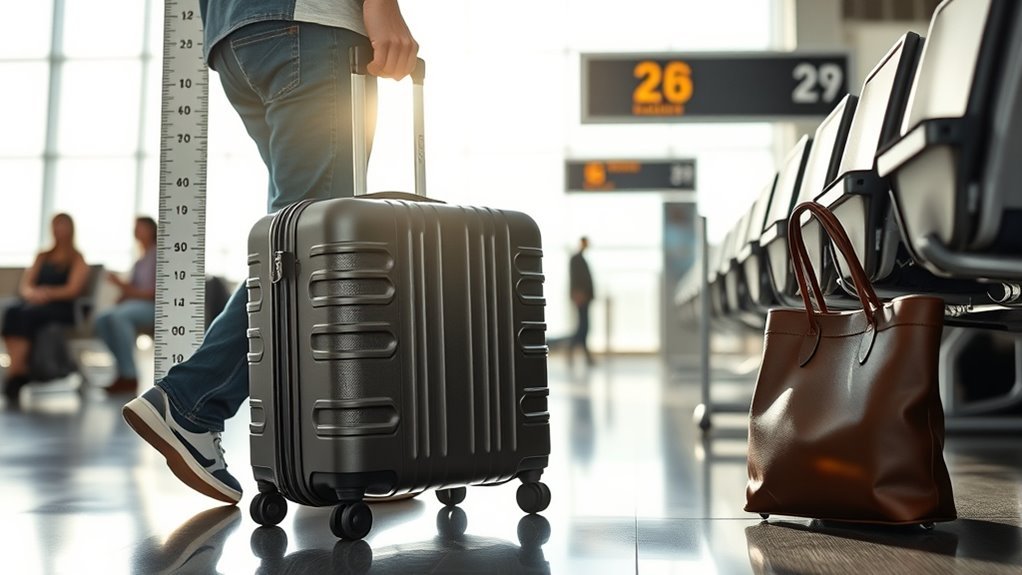
If you’re flying Basic Economy with American Airlines, you’ll need to know the carry-on size limits and what counts as a personal item.
You can usually bring a personal item that fits under the seat, but full-size carry-ons may be restricted unless you’re eligible to board earlier.
Also check your boarding group rules, since they determine whether you can gate-check or bring a bag into the cabin.
Carry-On Size Limits
Although American Airlines lets most passengers bring a carry-on, Basic Economy flyers face stricter limits: you’re only allowed one personal item that fits under the seat in front of you, and traditional overhead carry-ons aren’t included unless you have status, a premium ticket, or are traveling on certain transcontinental or international flights.
For other fares, carry-on dimensions mustn’t exceed 22 x 14 x 9 inches (including wheels and handles). If your bag’s larger, you’ll need to check it or pay oversize fees.
Measure carefully, pack efficiently, and confirm allowances before you fly to avoid surprises at the gate.
Personal Item Rules
Because Basic Economy limits your carry-on allowance, you can only bring one personal item that fits under the seat in front of you — no overhead bag is included unless you’ve got status, a premium ticket, or are on qualifying transcontinental/international routes.
You’ll need to choose wisely: a compact bag storing essentials, electronics, and valuables works best. Measure to confirm it stays within American’s typical underseat dimensions and pack to avoid spills or bulging. Keep receipts or meds accessible.
If you need more, consider upgrading or checking luggage to avoid gate-check fees and delays.
- Pack light and prioritize essentials.
- Measure and compress.
- Protect valuables and documents.
Boarding And Carry‑On
Once you’ve settled on a personal item for Basic Economy, you’ll need to understand how boarding and carry-on enforcement works so you don’t get caught off guard at the gate. You won’t get a complimentary overhead bag allowance, so only pre-paid or elite/credit-card perks let you bring a full carry-on.
Boarding order and gate agents determine enforcement; if overhead space is limited, agents may gate-check bags without compensation. Have your personal item ready to stow under the seat and know your fare rules.
Consider paying for a carry-on during booking if you need guaranteed overhead space and faster boarding.
Carry-On Allowances for Main Cabin and Higher Fares
If you’re flying Main Cabin or have a higher fare on American Airlines, you can bring one carry-on bag plus one personal item without extra charge, as long as the carry-on meets size limits (22 x 14 x 9 inches including wheels and handles).
You should pack smartly: use the carry-on for bulkier items and the personal item for essentials you’ll need inflight. Measure your bag including handles and wheels to avoid gate hassles.
If the flight is full, carry-ons may be gate checked for free; keep valuables in your personal item so they stay with you.
- Prioritize essentials
- Measure precisely
- Prepare for gate check
Carry-On Perks for AAdvantage Elite Members
While AAdvantage elite status doesn’t change the standard carry-on dimensions, it does give you practical perks that make boarding and overhead storage easier. You get priority boarding that lets you claim overhead space earlier, and agents often assist with gate checking or stowing bags. Loyalty can mean faster resolution if a bin’s full, and elites usually get flexible reboarding if a flight’s rearranged.
| Perk | Benefit | Tip |
|---|---|---|
| Priority boarding | Earlier bin access | Board when called |
| Gate assistance | Help with stowing | Ask politely |
| Flexible handling | Faster fixes | Show status card |
| Confidence | Less stress | Keep carry accessible |
Carry-On Rules in Premium Cabins and Transcontinental Flights
Because premium cabins and transcontinental routes often have different service levels, you’ll find more flexible carry-on treatment on those flights—larger overhead bins, priority overhead space, and leniency from gate agents about slightly oversized items.
On premium and transcontinental flights expect larger bins, priority stowage, and leniency for slightly oversized carry‑ons.
You can usually bring the standard carry-on plus a personal item, and flight attendants often help stow bags for you. Still, follow size limits to avoid surprises and pack essentials in your personal item.
- Priority stowage: You board earlier, so you’ll secure overhead space.
- Measured leniency: Slightly oversized bags may be accepted.
- Crew assistance: Staff can help gate-check or store items.
International Route Variations in American Airlines Carry-On Policy
When you fly internationally with American Airlines, carry-on rules can vary by route and destination, so check specific requirements before you pack. You’ll usually be allowed one carry-on bag and one personal item, but size limits, weight restrictions, and boarding procedures can differ for transatlantic, transpacific, and Latin America services.
Some destinations enforce stricter weight limits or require gate-checked bags on smaller jets. Customs and baggage regulations at your destination may affect what you can carry.
Always verify the specific flight’s rules on AA’s website or your booking confirmation to avoid surprises at the gate.
American Eagle Regional Flights: Carry-On Differences
When you fly on American Eagle regional routes, the carry-on rules can differ from mainline American Airlines. You’ll want to check specific size and weight limits since smaller regional aircraft may restrict larger bags or require gate-checked items.
Review the carrier’s guidance before you pack so you don’t face surprises at boarding.
Regional Carry-On Rules
Although American Eagle flights are operated under the American Airlines brand, regional jets often have stricter carry-on limits than mainline aircraft, so you should check size and cabin constraints before packing.
You’ll encounter narrower aisles, smaller overhead bins, and variable gate-check policies, so plan accordingly. Confirm rules with your booking and arrive early to secure bin space.
Consider these practical tips:
- Choose a compact bag that fits under the seat when possible to avoid gate-checking.
- Pack essentials in a small personal item for quick access and compliance.
- Be ready to gate-check bulky carry-ons without delay or dispute.
Size And Weight Limits
Because regional jets have tighter cabins and different bin dimensions, you’ll often face stricter size and weight limits on American Eagle flights than on mainline American Airlines routes.
Typically, your carry-on must fit under the seat or in smaller overhead bins; dimensions around 45 linear inches (length + width + height) can be enforced more strictly, and height or depth may be limited by sloped bins.
Weight limits vary by aircraft and crew discretion—expect lower practical limits than mainline. If your bag looks oversized or heavy, gate agents may require you to gate-check it.
Measure and weigh bags before travel to avoid surprises.
What Happens If Your Carry-On Is Oversized at the Gate?
- Try redistribution immediately
- Request accommodations politely
- Obtain and keep the gate-check tag
Fees for Gate-Checking or Checking Your Bag
If your carry-on won’t fit, you’ll need to gate-check it or check it at the counter, and each option can carry different fees.
You should know American’s gate-check policy—some items may be free while others incur a charge depending on fare class and route.
Also check the standard checked bag rates and any size/weight limits so you won’t get surprised at the airport.
Gate-Check Fee Policy
When you’re asked to gate-check a bag at boarding, American Airlines generally doesn’t charge for standard carry-ons that are gate-checked due to cabin space limits, though policies can vary by fare class and aircraft. Oversized or specialty items may incur fees.
You’ll usually drop the bag at the jet bridge and retrieve it at the door or baggage claim. Keep valuables and essentials with you. Confirm gate agent instructions and retain any claim tags.
If you’ve got strollers, car seats, or oversized luggage, expect different handling and possible charges—ask before boarding to avoid surprises.
- Know exceptions
- Keep essentials
- Ask agent
Checked Bag Charges
Wondering what you’ll pay to gate-check or check a bag with American Airlines? You’ll usually pay per checked bag unless you have status, a premium ticket, or a qualifying credit card. First checked bags on domestic routes often cost, with higher fees for additional pieces, oversize, or overweight charges. You should weigh and measure to avoid surprises. Typical fees vary by route and fare class, so check your booking. Visualize common scenarios:
| Bag | Fee (typical) | Notes |
|---|---|---|
| 1st checked | $30 | Domestic standard |
| 2nd checked | $40 | Larger charge |
| Oversize/overweight | $75+ | Depends on pounds |
How to Measure Your Bag Quickly at Home or the Airport?
Although measuring a bag seems fiddly, you can check dimensions in minutes with just a tape measure or a ruler and a flat surface.
Lay the bag flat or upright as you’ll carry it; include handles and wheels.
Lay the bag as you’ll carry it—flat or upright—and remember to include handles and wheels.
Measure height (top to bottom), width (side to side), and depth (front to back).
If at the airport, use a gate counter or suitcase sizer when available, but still measure to be sure.
- Measure straight lines, include protrusions.
- Round up to the nearest half inch or centimeter.
- Note measurements on your phone for quick reference.
Carry-On Dimensions That Reliably Fit American Airlines Bins
To make sure your bag fits, you’ll want to stick to American Airlines’ standard carry-on size (22 x 14 x 9 inches).
And know the typical personal item limits (smaller bag that fits under the seat).
If your luggage’s dimensions exceed those limits, consider alternatives like gate-checked, checked baggage, or a soft-sided bag that compresses.
Measure your bag before travel so you won’t be surprised at the gate.
Standard Carry-On Size
When you need a carry-on that will reliably fit in American Airlines overhead bins, aim for luggage no larger than 22 x 14 x 9 inches (56 x 36 x 23 cm) including wheels and handles; that size meets the airline’s standard allowance and gives you the best chance of stowing your bag without gate-checking.
Choose a hard- or soft-sided bag that maximizes internal space while staying within those dimensions. Pack strategically to avoid bulging. Measure before you fly. Consider lightweight designs to stay under weight limits without sacrificing capacity.
- Check dimensions precisely.
- Favor slim profiles.
- Pack compactly.
Personal Item Dimensions
Wondering how big your personal item can be to fit reliably under the seat on American Airlines? Aim for roughly 18 x 14 x 8 inches (45 x 35 x 20 cm) or smaller to be safe. That size typically slips under most domestic seats without blocking foot space.
Soft-sided bags compress better than rigid ones, so choose a flexible tote, small backpack, or briefcase. Pack essentials—documents, electronics, medications—in accessible pockets.
If you’re unsure, measure the bag fully packed and test it at home under a chair. Following these dimensions reduces gate hassles and speeds boarding.
Oversized Bag Alternatives
If your bag’s bigger than the personal-item guideline but you still want it in the cabin, consider carry-on sizes that reliably fit American Airlines overhead bins: aim for around 22 x 14 x 9 inches (56 x 36 x 23 cm) or slightly smaller, which matches AA’s published maximum and fits most bins on narrow- and wide-body aircraft.
Choose a hard-sided or compressible soft-sided roller that slides in easily, test dimensions before travel, and pack strategically to avoid gate check.
- Pick bags near maximum to maximize capacity.
- Favor lightweight materials for airline weight limits.
- Use packing cubes to organize and compress.
Soft-Sided vs Hard-Sided Carry-Ons: Which Fits Better on AA?
Because American Airlines strictly enforces overhead-bin dimensions, choosing between a soft-sided and hard-sided carry-on comes down to how you prioritize flexibility versus protection.
You’ll find soft-sided bags compress slightly, letting you squeeze into tight bins and slide around awkward shapes; they often have exterior pockets for quick access.
Hard-sided suitcases keep fragile items safer and resist crush damage, but they don’t compress and can be harder to fit when bins are crowded.
If you pack irregular items or anticipate gate-checking, soft-sided offers adaptability.
If you carry electronics or breakables and want rigid protection, choose a hard shell.
Carry-On Features That Maximize Usable Space
Look for zipper compression compartments to squeeze more into the same bag without bulging past AA’s size limits.
Use external expandable pockets for last-minute extras like a jacket or travel pillow that you can tuck away when boarding.
These features help you pack smarter and stay within carry-on rules.
Zippered Compression Compartments
When you zip down a compression compartment, you instantly reduce bulk and lock garments or gear into a flatter, more efficient layer that fits better in overhead bins. You’ll notice less shifting, fewer wrinkles, and the ability to carry more without exceeding size limits.
Use compression for soft items—clothes, light jackets, and packing cubes—then place rigid items around them to protect shape.
Check zippers for smooth operation before travel to avoid stuck compartments at the gate.
Thoughtful packing with compression helps you meet American Airlines carry-on dimensions while maximizing usable volume.
- Prioritize soft items
- Protect rigid pieces
- Test zippers preflight
External Expandable Pockets
Compression compartments shrink bulky soft items, but external expandable pockets give you quick-access space for items you need on the fly. You’ll appreciate pockets that expand outward without altering overall bag dimensions, letting you stash a water bottle, jacket, or snacks while keeping the main compartment organized.
Look for robust zippers and gussets that lock open smoothly and won’t sag when filled. Use them for things you’ll grab during boarding or security: passport, phone, headphones, or a lightweight sweater.
Properly packed expandable pockets save time and keep essentials reachable without rummaging through your carry-on’s core storage.
How to Compress Clothes and Save Space Legally?
If you want to fit more into your American Airlines carry-on without risking gate-checks, start by rolling and tightly folding garments to minimize air pockets and layering heavier items at the bottom. You’ll use legal, non-destructive techniques to compress clothing while keeping fabrics wrinkle-free and accessible.
Use compression cubes or packing folders to organize by type and squeeze out trapped air without vacuum bags that might attract inspection. Balance weight and shape so your bag keeps dimensions within limits and security checkpoints stay smooth.
- Use soft items to fill gaps and stabilize structure.
- Pack worn clothes to reduce volume.
- Layer toiletries in clear pouches.
Packing Strategies to Stay Within American Airlines Limits
Since airline limits are about both size and weight, you’ll want to plan your packing so your carry-on keeps within American Airlines’ 22 x 14 x 9 inch guideline and the typical checked-bag weight expectations.
Start by choosing a lightweight, structured bag that fits overhead bins snugly. Roll clothes and nest smaller items in shoes to maximize space. Pack versatile outfits and limit duplicates; wear your bulkiest layers on board.
Use travel-sized toiletries and consolidate into one clear bag for security. Keep heavier items low and centered for balance. Finally, weigh your bag at home to avoid surprises at the gate.
Electronics, Batteries, and American Airlines Carry-On Rules
When you’re packing electronics, remember American Airlines lets most devices in carry-on bags but restricts certain batteries and spare cells—so keep lithium-ion batteries installed in devices when possible and place spare batteries in your carry-on, protected from short circuits.
You should know battery size limits, device screening may require removal, and damaged or recalled batteries are prohibited. Keep devices charged enough for security checks and stow cables neatly to avoid delays.
Follow airline staff instructions if screening flags an item.
- Inspect batteries for damage and use protective covers.
- Carry spares only in your cabin, insulated.
- Declare large batteries when asked.
Liquids, Gels, and TSA 3-1-1 on American Airlines Flights
You’ll need to follow TSA’s 3-1-1 rule when packing liquids and gels for an American Airlines flight: put containers 3.4 ounces (100 ml) or smaller into a single clear quart-sized bag.
Only one quart bag per passenger is allowed, so organize full-size toiletries in checked luggage or buy smaller travel sizes.
Pack the quart bag where it’s easy to remove at security to keep lines moving.
TSA 3-1-1 Rule
Though airport security can feel strict, the TSA 3-1-1 rule keeps liquids and gels simple for carry-ons on American Airlines flights. You’ll pack thoughtfully to speed screening and avoid tosses. Keep everything accessible in a clear quart-size bag and know rules apply per passenger, not per bag. Be ready to remove the bag at checkpoints if asked.
- Pack only what you need to reduce delays and wasted space.
- Place the bag on top in your carry-on or in an outer pocket for quick access.
- Expect consistent enforcement; follow staff directions to move through security.
Allowed Container Sizes
Security screening rules also dictate the sizes of containers you can bring, so after organizing your liquids into that quart-size bag you’ll want to confirm each item meets the limits. You can carry liquids, gels, and aerosols in containers of 3.4 ounces (100 milliliters) or less each, all fitting in one clear quart-size bag per person. Larger medically necessary or baby items are exceptions but require inspection. Know that solid cosmetics aren’t restricted the same way. Below is a quick comparison to help you visualize permitted container types and typical examples.
| Item Type | Max Size | Examples |
|---|---|---|
| Liquid | 3.4 oz | Shampoo |
| Gel | 3.4 oz | Hair gel |
| Aerosol | 3.4 oz | Deodorant |
| Exceptions | >3.4 oz inspected | Medication |
Packing Tips For Liquids
Wondering how to pack your liquids to breeze through TSA screening? You’ll follow the 3-1-1 rule: each container 3.4 oz (100 ml) or less, all fit in one clear quart bag, one bag per passenger. Pack the quart bag at the top of your carry-on for quick removal.
Seal sticky products in a disposable plastic bag to prevent leaks. Consider solid alternatives (bar shampoo, solid lotion) to save space and bypass liquid limits.
- Consolidate: decant to travel-sized bottles.
- Organize: use a clear, labeled quart bag.
- Protect: cushion bottles and double-bag.
Bringing Sports Gear or Musical Instruments as Carry-On
If you plan to bring sports equipment or a musical instrument on board, know that American Airlines lets many items travel as carry-on but enforces size, weight, and storage rules you’ll need to meet.
You should check dimensions: items must fit in overhead bins or under the seat; otherwise you may gate-check them. Soft cases are easier to squeeze in.
Heavier or bulky gear like bikes, hockey bags, and oversized instruments often need prior approval or may incur fees.
Always measure and weigh your item, contact AA for special stowage requests, and arrive early so staff can help with boarding and placement.
Traveling With Medical Equipment or Mobility Aids
If you need to bring medical devices or mobility aids, know American Airlines’ size and carriage rules so your gear travels with you.
You should notify the airline in advance and have any required documentation or medical letters ready.
Also check how mobility aids will be handled at gate and baggage claim so you’re not surprised on arrival.
Medical Device Carry Rules
Traveling with medical equipment or mobility aids requires knowing American Airlines’ specific carry rules so you can board and move through security without hassle.
You can bring necessary medical devices onboard in addition to your carry-on; notify the airline ahead, label equipment, and pack supplies separately for screening.
Batteries, oxygen concentrators, and medications have rules—check capacity limits and bring prescriptions or a doctor’s note.
Communicate gate needs early to get boarding assistance if needed.
- Notify airline in advance to confirm device allowance.
- Prepare documentation for medications and powered devices.
- Pack spare batteries and secure parts for inspection.
Mobility Aid Handling
When you rely on a wheelchair, scooter, cane, or other mobility aid, American Airlines will accommodate it through security and at the gate, but you should notify the airline in advance and be prepared for inspection and handling procedures.
You’ll usually check large devices at the gate; agents may tag, store, or require folding. Batteries—especially lithium—have specific rules; removable batteries may need to travel in the cabin.
Staff will assist with boarding, stowage, and retrieving your aid; carry any necessary accessories separately as allowed.
Inspect your aid on arrival and report damage immediately so claims can be processed.
Documentation And Notification
Having your mobility aid properly documented and notifying American Airlines ahead of time helps avoid delays and guarantees staff can meet your needs. You should register equipment during booking, note battery types, and request gate-check or onboard stowage when needed. Bring proof of ownership or a physician’s note if required, and keep contact info handy.
- Register equipment in reservation notes and call 24–48 hours before departure.
- Document battery type (wet, dry, lithium) and pack according to regulations.
- Carry ownership proof and a medical letter; alert gate agents on arrival.
These steps reduce surprises and ensure smoother travel.
Family Travel: Carry-On Tips With Kids and Strollers
If you’re juggling kids, snacks, and a stroller, knowing American Airlines’ carry-on and gate-check rules can save time and stress at the gate. Pack essentials—diapers, wipes, medications—in a soft bag you can tuck under the seat.
Use a compact stroller that meets gate-check guidelines; you’ll usually gate-check it and retrieve it at the jet bridge.
Keep one personal item per adult for kids’ items and a lightweight blanket or change of clothes.
Label bags and the stroller with contact info.
Arrive early to request space and make boarding smoother for you and your family.
Duty-Free Purchases and Fitting Them in Carry-On Space
Because duty-free bags can be bulky or rigid, plan where they’ll go before you leave the store so they fit easily in your carry-on or under the seat. You’ll want to assess size, protect fragile items, and consider liquids rules—especially if you have connecting flights.
Plan where bulky duty-free bags will go—fit them in carry-on or underseat, protect fragile items, and mind liquids rules.
Place heavier purchases at the bottom, keep receipts handy for security, and use soft gaps for oddly shaped boxes. If space’s tight, rearrange nonessential items into checked luggage or wear a jacket with deep pockets for small purchases.
- Prioritize fragile/liquid items for easy access
- Distribute weight to stabilize your bag
- Keep receipts and seals visible
What to Do If Overhead Bins Are Full During Boarding?
When you find the overhead bins full as boarding proceeds, stay calm and act quickly: scout for space in nearby rows, ask a flight attendant for help, or be ready to gate-check your bag.
If you spot a small gap, gently slide your bag in and flatten soft items to fit; avoid forcing hard-shell suitcases. Offer to lift or rearrange a fellow passenger’s item politely if they agree.
If no space appears, volunteer to gate-check right away to avoid delays. Label your bag clearly and keep essentials in a personal item.
Follow crew instructions; they’ll handle logistics and timing.
How to Secure Overhead Bin Space Quickly
Want that prime overhead spot? Act fast: arrive early, gate-check timing and carry your bag onto the jetway so you’re ready when boarding starts. Position yourself to board in Group 1–3 or ask gate staff politely about early overhead access. Use a slim, compliant carry-on so it fits easily above any seat.
- Board early: be first at the gate, ready to step on.
- Be strategic: pick seats near the front or exit rows for quick bin access.
- Pack smart: compress items, use soft sides, and place essentials in a personal item.
When to Gate-Check Proactively to Avoid Delays
If you’ve got a bulky bag that might slow boarding or risk being gate-checked last, hand it over early—either as you board or right after you pass the jetway—so you don’t hold up other passengers or scramble for space at the end. Do it when overhead bins are already filling, if you’re in later boarding groups, or when flight attendants ask for gate-checks. Tag it visibly, keep essentials with you, and accept the quicker exit at your destination. Proactive gate-checking smooths boarding and reduces stress.
| When | Why | Tip |
|---|---|---|
| Late boarder | Bins full | Offer early |
| Bulky bag | Slows others | Gate-check now |
| Full flight | Limited space | Tag clearly |
| Tight connection | Need speed | Prioritize essentials |
| Standby | Uncertain | Gate-check early |
How to Appeal a Carry-On Decision at the Gate
Although gate agents make quick calls to keep boarding on schedule, you can still appeal a carry-on decision calmly and confidently. Stay polite, state your case succinctly, and show measurements or receipts if your bag fits American Airlines’ dimensions. Ask for a supervisor if the agent won’t reconsider. Keep tone firm but respectful to avoid escalation.
- Explain briefly why the bag meets size rules and offer to demonstrate with a carry-on sizer or tape measure.
- Mention loyalty status or special needs if applicable.
- Request supervisor review or note for future flights if denied.
Carry-On Models That Reliably Meet American Airlines Rules
When you’re choosing a reliable carry-on for American Airlines, pick models that consistently meet the 22 x 14 x 9-inch (including wheels and handles) limit and have a slim, structured profile that fits overhead bins easily.
Look for hard-shell spinner suitcases labeled cabin-size, carry-on backpacks with rigid frames, and wheeled totes with removable straps.
Choose cabin-size hard-shell spinners, structured carry-on backpacks, or wheeled totes with removable straps for easy overhead storage.
Prioritize brands that publish exact exterior dimensions and offer compression or expandable panels that stay within limits.
Test the bag’s fit in airport sizers before travel.
Choose lightweight construction, sturdy telescoping handles, and organized interiors so you’ll avoid surprises at the gate.
Common Traveler Sizing Mistakes to Avoid (Real Examples)
After picking a bag that fits the 22 x 14 x 9-inch guideline, you’ll still face common sizing mistakes travelers make that can cost time and money. You might overpack to avoid checked fees, ignore expandable zippers, or buy a stylish but oversized roller that won’t fit the overhead.
Learn from real examples: friends stuck repacking at the gate, someone charged for a slightly too-large bag, and a commuter who’d to gate-check an expensive suitcase.
- Overpacking because you assume “it’ll squeeze.”
- Relying on expansion without measuring.
- Choosing style over verified dimensions.
Carry-On Compliance Checklist: Measure, Weigh, Pack
Before you head to the airport, run through a simple checklist: measure your bag (including wheels and handles), weigh it, and pack strategically so you meet American Airlines’ 22 x 14 x 9-inch guideline without surprises.
Use a tape measure and round up fractions; include protruding handles. Weigh your loaded bag on a bathroom scale or luggage scale, subtracting any personal item if needed.
Pack dense items low and against wheels, use compression cubes, and avoid overstuffing exterior pockets.
Keep liquids in a clear quart bag and place valuables on top.
If unsure, swap items to a carryable personal bag to comply.
Frequently Asked Questions
Can I Bring a Duty-Free Liquor Bottle Through U.S. Customs in Carry-On?
Yes — you can bring a duty‑free liquor bottle through U.S. customs in carry‑on if it’s sealed in the tamper‑evident bag with receipt and you declare it; otherwise TSA or customs may confiscate it.
Are Small Inflatable Pillows or Blankets Allowed in Carry-On Without Counting?
Yes — you can bring small inflatable pillows or blankets in your carry-on without them counting as extra items, provided they’re packed or tucked inside your main carry-on and meet airline and TSA size/security rules.
Do Emotional Support Items (Not ESA Pets) Count as Personal Items?
Yes — emotional support items count as personal items if they’re carried aboard; you’ll need to stow them within your allowed personal-item space, and they shouldn’t exceed size or safety restrictions set by the airline or TSA.
Can I Bring Unopened Over-The-Counter Medications in Carry-On Internationally?
Yes — you can bring unopened over-the-counter medications in your carry-on for international travel, but check destination and airline rules, pack originals with labels, declare if required, and keep receipts for customs or security inspections.
Does Connecting Through a Partner Airline Change Carry-On Allowance?
Yes — if you connect on a partner flight, the carry-on allowance usually follows the operating carrier’s rules, not American’s, so you’ll need to check the partner airline’s size and item limits before you board.
Conclusion
You now know American Airlines’ carry-on size: 22 x 14 x 9 inches including wheels and handles, with no universal weight limit for most domestic flights. Measure your bag curb-to-handle, weigh it before you go, and choose a model built for overhead-bin fit. If an agent flags your bag, stay polite and ask to appeal. Pack smart, avoid common sizing mistakes, and use the checklist so you won’t be surprised at the gate.