What Size Luggage Fits Under Seat
You’ll generally want a soft-sided personal item about 16–18 inches long, 10–12 inches high and 6–9 inches deep to fit under most airline seats; soft fabric compresses so you’ll have an easier time than with a hard case. Measure packed dimensions including wheels and handles, check your carrier’s limits, and favor slim backpacks or totes with tuck-away straps. Pack essentials and fragile items thoughtfully, and keep going to learn sizing nuances and packing tricks that help avoid gate‑check.
Quick Answer: Common Under‑Seat Dimensions
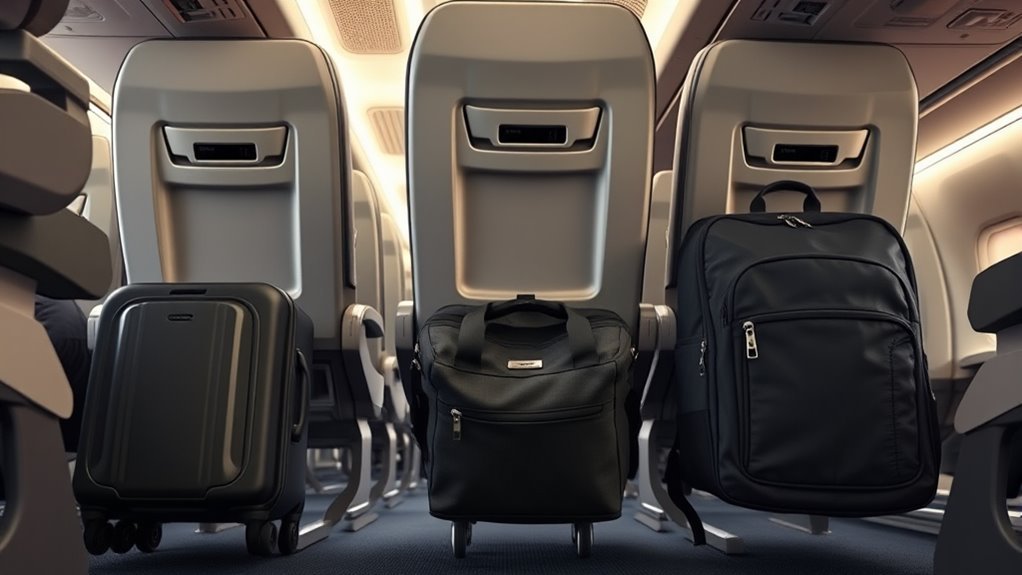
While under‑seat dimensions vary by airline and aircraft, most carriers accept bags around 18 x 14 x 8 inches (45 x 35 x 20 cm). You’ll find variations: some allow slightly taller or deeper bags, others limit width more tightly.
Measure your bag including wheels and handles; soft-sided bags can compress for a better fit. Typical budget and domestic jets follow that 18x14x8 guideline, while regional turboprops and some international carriers may differ. Additionally, checked luggage policies can impact your overall packing strategy, so be sure to review them.
Check your airline’s published under‑seat dimensions before travel, and test fit the bag in your car or closet to guarantee it’ll slide under the seat easily.
Why Under‑Seat Size Matters for Fees and Boarding
What fits under the seat can affect whether you pay a carry-on fee or only bring a personal item. If your bag meets the under‑seat size, you’ll often avoid extra charges and keep boarding simple. Conversely, oversize items can force gate checks and slow down boarding, so size matters for both fees and priority. Additionally, knowing airline carry-on size limits helps ensure your bag fits comfortably under the seat, preventing any last-minute surprises.
Airline Fee Differences
Why does under‑seat luggage size matter so much for fees and boarding? You’ll face different policies: some airlines count any carry-on toward a fee if it’s not strictly under the seat, others allow a personal item free.
If your bag fits under the seat, you avoid paid overhead space or checked baggage charges. Low-cost carriers often enforce strict dimensions and charge when you exceed them.
Knowing size limits saves you money and prevents last-minute gate fees. Measure your bag, check airline rules, and choose a compliant personal item to keep travel costs predictable and avoid surprises at the gate.
Boarding Priority Impact
Because under‑seat luggage lets you board with a guaranteed place for your bag, it directly affects your boarding experience and potential fees. You’ll avoid gate-checking, last-minute overhead bin battles, and some airlines’ carry-on fees by choosing a compliant under‑seat bag.
Boarding priority often favors passengers with personal items; if your bag meets dimensions, you’ll board earlier and settle quickly. That reduces stress and speeds deplaning.
Conversely, oversized bags can force you to gate-check, incur charges, or lose priority boarding privileges. Measure before you pack, know airline rules, and pick a slim, sturdy bag to keep fees and hassles down.
How Airlines Treat “Under‑Seat” and Personal Items
Airlines don’t all define “under‑seat” and personal items the same way, so you’ll want to check each carrier’s rules before you pack.
Size matters, but placement — whether it fits under the seat or must go in the overhead — often determines if it’s allowed.
Also watch for carriers that treat oversized personal items as carry‑ons and charge fees accordingly. EasyJet, for instance, selectively enforces size limits for cabin luggage to ensure compliance with their policies.
Airline Definitions Vary
Since each carrier sets its own rules, what counts as “under‑seat” or a free personal item can change a lot depending on who you fly with. You’ll see strict dimensional limits at some airlines, looser definitions at others, and varied enforcement by gate agents.
Low‑cost carriers often restrict both size and weight, while legacy airlines may allow slightly larger items if they fit under the seat. Some carriers include laptop bags as personal items; others treat them separately.
Always check your airline’s policy before packing, measure your bag, and be ready to gate‑check if staff decide it won’t fit.
Size Versus Placement
Knowing an airline’s definition is only half the story — how they treat size versus where you place the bag matters just as much. You’ll find similar-sized items handled differently: a slim tote under the seat in front fits easily, while a bulkier backpack might be tagged as carry‑on and gate‑checked if it blocks aisles.
Gate agents judge placement practicality, not just measurements. If you stow a soft bag under the seat but shove it partly into the footwell, they might insist it goes overhead.
Pack with flexible shapes, test under-seat fit before boarding, and be ready to adjust quickly.
Carry‑On Exceptions and Fees
Because carriers vary so much in what’s allowed for free and what triggers a fee, you should check both the size rules and the fine print about exceptions before you pack.
Airlines often exclude items like duty‑free bags, infant gear, medical devices, or premium fares that include a larger personal item.
Low‑cost carriers may charge for any bag beyond a small personal item, while legacy airlines sometimes allow a tote plus a small under‑seat suitcase.
Measure and weigh your bag, note airline definitions of “personal item,” and consider paying for priority boarding to guarantee overhead space if your under‑seat option is limited.
Under‑Seat Dimensions: Major U.S. Carriers
When you’re choosing a carry-on to stash under the seat, be aware that each major U.S. carrier sets its own usable dimensions and tolerances, so a bag that fits on one airline might be a squeeze on another. You’ll want to check specific measurements before you pack: low‑cost carriers typically allow smaller under‑seat bags, legacy carriers vary by aircraft and cabin, and gate agents enforce practical fit more than printed limits. Use this quick reference to compare typical allowances and decide which bag will reliably slide under seats without delay.
Additionally, it’s important to remember that baggage transfer policies can impact what you can carry on, especially during connecting flights.
| Airline type | Typical under‑seat size |
|---|---|
| Low‑cost | 16×10×8 in |
| Legacy | 18×14×8 in |
| Regional | 15×12×7 in |
| Flexible | Varies by plane |
Under‑Seat Dimensions: Popular International Airlines
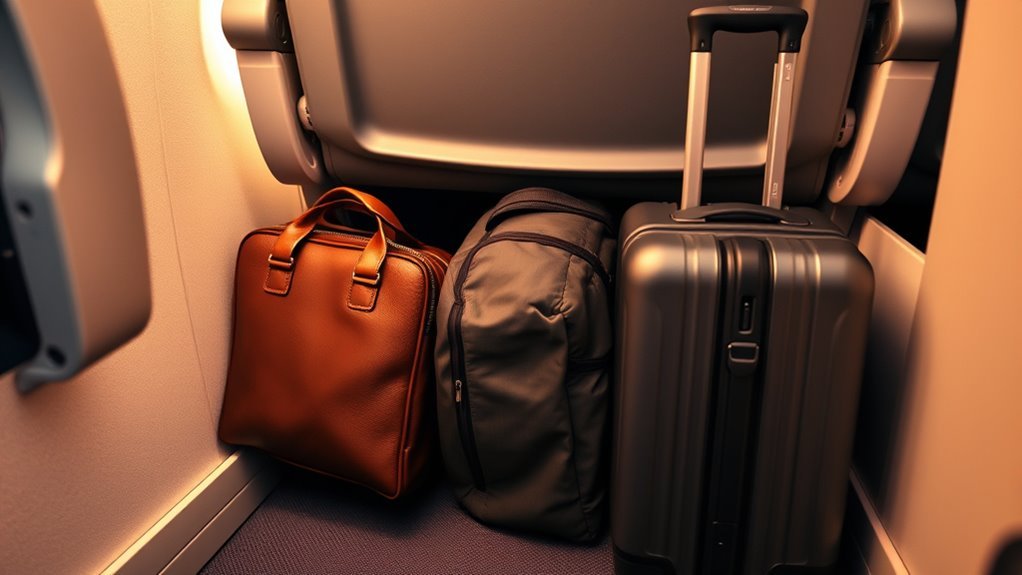
Although airlines worldwide set different under‑seat limits, you can usually narrow choices by region and cabin class—Europe and Asia often allow slightly larger bags than budget carriers, while Middle Eastern and some African airlines stick to tighter dimensions.
Airlines vary—Europe and Asia often allow larger under‑seat bags; Middle Eastern and some African carriers are tighter.
When flying major carriers like British Airways, Lufthansa, or ANA, check business and premium economy allowances for extra under‑seat space; economy remains more restrictive.
Low‑cost European and Asian operators enforce compact measurements strictly. Middle Eastern airlines often prioritize checked and overhead stowage, keeping under‑seat spots minimal.
Always verify your airline’s published under‑seat policy before packing to avoid gate hassles.
Typical Under‑Seat Size Ranges to Expect
If you’re wondering what’ll reliably fit under a plane seat, expect most airlines to accept bags that measure roughly 16–18 inches long, 10–12 inches high, and 6–9 inches deep (40–46 × 25–30 × 15–23 cm).
Within that range, you’ll commonly see three practical categories: compact tote/backpacks (around 16×10×6″), slim underseat carry-ons (17–18×11–7″) that maximize length without bulk, and slightly taller soft-sided bags (16–18×12×8–9″) that compress to fit.
Choose materials and shapes that avoid hard edges, and prioritize pockets and accessible compartments so essentials stay reachable during boarding and deplaning. Additionally, knowing luggage policies can help ensure your bag meets airline requirements and avoids last-minute surprises.
How to Measure Your Bag for Under‑Seat Fit
Because cabin space varies so much, measuring your bag precisely beats guesswork: lay it flat, extend any straps or wheels the way they’d sit under a seat, and measure the longest, tallest, and deepest points (length × height × depth).
Use a rigid tape or ruler for accuracy, recording dimensions in centimeters and inches.
Compare those numbers to your carrier’s published under‑seat limit, allowing a small clearance for irregular shapes.
If your bag’s shape changes, measure in its packed, zipped state.
Note wheels and handles that protrude; they count.
Recheck after packing to guarantee nothing pushes dimensions beyond the limit.
Which Seat Types Change Under‑Seat Space
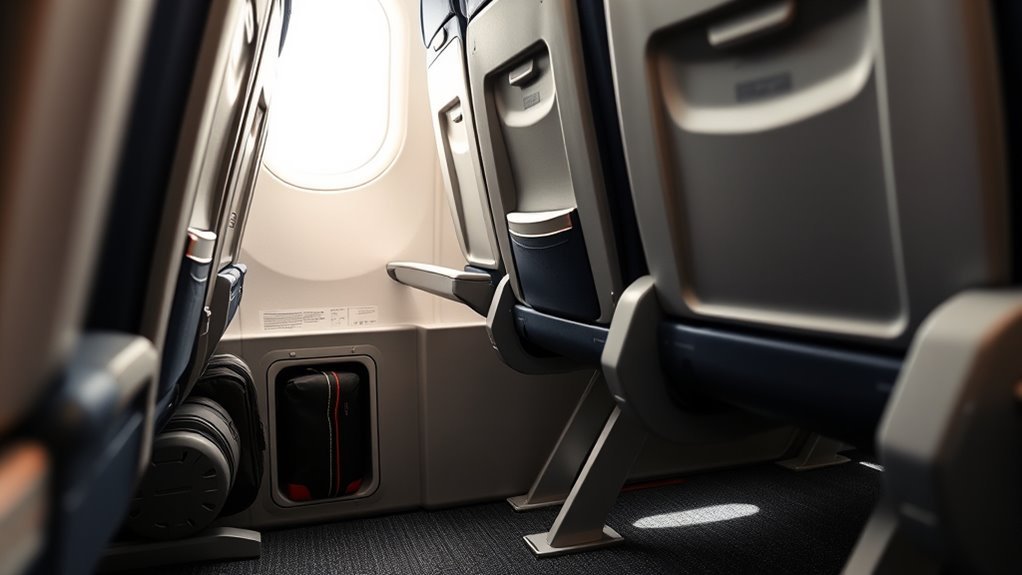
When you pick a seat, remember that under‑seat space can change dramatically depending on type—center, window, aisle, exit row, bulkhead, and premium seats all differ in clearance and obstruction.
You’ll find aisle seats often give easier access but slightly less horizontal space due to tray support and armrest mechanisms. Window seats may slope beneath the fuselage, reducing usable height. Center seats can be tight laterally.
Bulkhead seats eliminate under‑seat storage entirely, while exit rows sometimes have limited or no space for bags.
Premium economy and upgraded zones usually offer more room, but always check airline specifics before you pack.
Business & First‑Class Under‑Seat Differences
After comparing standard economy seat types, you’ll notice business and first-class cabins offer markedly different under‑seat options. You’ll usually find less accessible space because seats recline into wells or have fixed partitions, and some airlines relocate storage to overhead bins or dedicated compartments. That changes what you can stow and how quickly you can access it.
- Accessibility: You’ll often have reduced accessibility—larger footrests or ottomans block entry beneath the seat.
- Depth and height: The usable depth and height vary widely; soft totes fit easier than hard-sided carry-ons.
- Policy and service: Crew may request items be stowed differently for service and safety.
Real Tests: Fit on Common Aircraft Models
To show what actually fits, we tested common carry-ons and soft bags under seats on several popular aircraft types so you can see realistic outcomes rather than rely on specs alone.
You’ll see consistent patterns: narrow regional jets (Embraer, CRJ) accept only slim soft bags and tiny hard-shell totes; single-aisle planes (A320, 737) handle medium soft duffels and compact rollerboards when positioned wheels-first; widebodies (787, A330) offer generous under-seat depth, fitting larger soft luggage but still limiting tall rigid cases.
You should place soft-sided items sideways, compress when possible, and avoid stacked rigid bags to maximize under-seat capacity.
My Bag Meets Specs but Won’t Fit : Troubleshooting
Although your suitcase meets the airline’s stated dimensions, it still mightn’t slide under the seat because seat frames, armrests, and protruding hardware vary by aircraft and row. You’ll want to troubleshoot quickly: try angling the bag, removing loose items, or shifting to a different row. If it still won’t fit, request help from flight attendants before boarding closes.
- Angle and slide: rotate the bag lengthwise or tilt to clear obstructions.
- Thin it out: move bulky items to your personal item or wear layers.
- Swap seats early: choose a spot with more under-seat clearance when possible.
Gate‑Check Risks and How to Avoid Them
If your bag gets gate-checked, you could face delays, lost or damaged items, and extra handling fees.
You can avoid most gate-check incidents by choosing a truly under-seat size, boarding early, and stowing soft or compressible items in a smaller personal bag.
Also label and pad valuables so you’re protected if gate-check becomes unavoidable.
Gate‑Check Consequences
When an airline asks you to gate‑check your bag, you’re handing it off to ground staff and accepting a few risks you wouldn’t face with under‑seat storage. You might get delayed retrieval, superficial scuffs, or, rarely, damage and lost items. Know consequences so you can react quickly.
- Delayed return: Your bag may be inaccessible until deplaning or baggage claim, disrupting connections or immediate needs.
- Cosmetic damage: Handles, wheels, and shells can get scratched or dented during loading and transport.
- Missing contents: Zippers or weak seams can open; small items sometimes fall out or get misplaced.
Preventing Gate‑Check Incidents
Because gate‑checking hands your bag to staff, you should take a few simple steps to cut the risks: lock or secure zippers, remove valuables and electronics, use a sturdy tag or cover, and clearly label the bag with your contact info.
Before boarding, weigh and compress your pack to avoid surprises that trigger gate‑check. Choose a compact, durable bag that fits under most seats to reduce the chance it’s taken.
Keep essential items in a small personal bag you can keep onboard. Photograph contents and the exterior condition before handing it over to document any damage or loss.
Choose the Right Under‑Seat Size: Proven Dimensions
Wondering what dimensions will reliably slide under an airplane seat? You want luggage that fits most cabins without fuss. Aim for compact, rectangular shapes that maximize usable volume while staying within common under‑seat limits.
- 17 x 13 x 8 inches — a proven safe maximum on many domestic carriers; fits snugly under most economy seats.
- 16 x 12 x 7 inches — offers extra clearance for varied seat frames and legroom configurations.
- 15 x 11 x 6 inches — ideal if you frequently fly smaller regional jets or want guaranteed fit.
Measure the bag including wheels and handles before you buy.
Best Carry‑On Backpacks for Under‑Seat Fit
You’ll want a backpack with compact dimensions that actually fits typical under‑seat spaces without squishing your gear.
Look for smart organization and quick access pockets so you can reach essentials on the fly.
Prioritize durable materials and comfortable straps so the bag lasts and feels good when you’re carrying it.
Compact Dimensions Guide
When space under the airplane seat is at a premium, choosing a backpack with compact, well-considered dimensions makes travel smoother and less stressful. You want low-profile depth (9–11 inches), moderate height (14–17 inches), and slim width (10–13 inches) so the pack slides under most seats and stays stable.
Measure seat clearance if you can and pick flexible materials that compress without bulging. Balance capacity with shape to avoid obstructing legroom.
- Depth: 9–11 in for under-seat clearance
- Height: 14–17 in to fit beneath most seats
- Width: 10–13 in for stable, unobtrusive placement
Organization And Access
How do you keep essentials handy without sacrificing under-seat space? Choose a backpack with dedicated, low-profile pockets: a front quick-access pocket for your phone, boarding pass, and earbuds; a flat tablet sleeve that doesn’t add bulk; and internal mesh organizers for cables and chargers.
Use removable pouches to group toiletries and cords so you pull only what you need. Opt for external side pockets for a water bottle that folds away when empty.
Arrange items by frequency of use—most accessible up front, seldom-used deeper down. That way you stay organized, pass through security quickly, and maximize under-seat capacity.
Durable Materials And Comfort
Keeping things organized is only part of the equation—your backpack also has to stand up to travel wear and feel comfortable under the seat. You want durable fabrics like ballistic nylon or ripstop that resist tears and abrasion, plus water‑resistant coatings to protect gear. Reinforced stitching and quality zippers keep seams intact during repeated stuffing.
Shoulder straps should be padded but slim, and a low‑profile back panel prevents bulking under the seat while still offering support. Look for lightweight frames or internal panels that hold shape without increasing size.
- Durable materials: ballistic nylon, ripstop, water resistance
- Reinforcement: taped seams, strong zippers
- Comfort: slim padding, low‑profile support
Top Compact Luggage Models That Usually Fit
If you want carry-on convenience with true under-seat fit, choose compact bags designed for tight spaces. Look for 18–20″ spinner carry-ons, structured underseat totes, and slim rolling backpacks from brands like Samsonite, Travelpro, and Briggs & Riley.
You’ll prefer models with low-profile wheels, recessed handles, and external pockets for quick access. Measure airline under-seat dimensions before buying; many “underseat” bags still vary.
Prioritize lightweight build and expandable panels only if they compress. Test zipper and wheel clearance against your typical seat row. These choices maximize storage while slipping easily beneath most airline seats.
Soft vs Hard‑Shell: Which Squeezes Under the Seat
You’ll notice soft cases squeeze into tight spots because their fabric and padding compress.
Hard shells don’t compress, so they keep shape and can block snug under-seat gaps.
Decide whether flexibility or rigid protection matters more for your items.
Soft Cases Compress Better
Because soft-sided cases can compress, they usually give you a bit more wiggle room under a plane seat than rigid shells do. You can squeeze them into tight gaps, mould them around seat supports, and still access essentials without unpacking. Fabric and flexible panels let you adapt to varying under-seat dimensions, so you’ll fit slightly larger loads.
- Pack softer items against the case edges to maximize compression.
- Use external pockets for flat items to keep the main compartment flexible.
- Avoid overstuffing; a moderately filled soft case compresses best and slides under seats with less hassle.
Hard Shells Maintain Shape
While hard-shell cases won’t squeeze into awkward gaps like fabric bags, they keep their shape so you can predict exactly how they’ll fit under a seat. You’ll know when it fits flush or needs to go vertically. That predictability helps you pack strategically: place flat items, use internal straps, and avoid awkward bulges. Choose a case with slightly rounded corners and low profile handles to maximize space. Use this quick comparison to weigh pros and cons before you buy.
| Advantage | Consideration |
|---|---|
| Predictable fit | Rigid, won’t compress |
| Better protection | Less flexible for odd spaces |
| Stable stack | Slightly heavier |
| Easy cleaning | May hit seat frame |
External Pockets, Straps, and Compression Features That Matter
Although under-seat bags must meet size limits, external features like pockets, straps, and compression systems determine how usable that space really is. You’ll want reachable zippered pockets for documents, phone access, and quick snacks without opening the main compartment.
Secure external straps keep bulky items stable and let you attach a light jacket or small tripod. Built-in compression panels or straps let you cinch volumes tighter so the bag slides under seats more easily and won’t expand during stowage.
Check pocket orientation, strap tuck-away options, and compression range to guarantee real-world convenience.
- Zippered external pockets
- Tuck-away straps
- Compression panels
Packing Hacks to Maximize Under‑Seat Space
When you only have the under‑seat cubby to work with, every inch and ounce counts, so pack with purpose. Roll clothes tight to save volume and use packing cubes to compress layers and keep items organized.
Stash flat things—documents, tablets, thin shoes—along the sides and bottom to build a stable base. Fill gaps with socks, chargers, and toiletries in reusable pouches to prevent wasted voids.
Choose dual‑purpose items and lightweight fabrics. Place heavier items nearest the bag’s spine to maintain shape.
Finally, reconsolidate before boarding so you can tuck one last thing into any freed space.
What to Pack in Your Under‑Seat Personal Item
Because you’ll likely be the only person accessing this bag midflight, pack it with the things you need most: travel documents, phone and charger, wallet, medications, a lightweight sweater or scarf, noise-cancelling earbuds, and a small toiletry kit for freshening up. Keep fragile items cushioned, use zip pockets for cords, and store liquids in a clear bag. Balance weight so it slips underseat easily. Think essentials, not backups. Before boarding, confirm you can reach what you’ll need without unpacking everything.
- Entertainment: tablet, paperback, headphones
- Health: meds, hand sanitizer, tissues
- Convenience: portable charger, pen, mask
When to Buy Airline‑Approved Personal‑Item Luggage
If you travel often or want to avoid last‑minute surprises at the gate, buy airline‑approved personal‑item luggage before your trip rather than waiting. When you know your carrier’s size limits, shop early to compare models that meet dimensions, durability, and organizational needs.
Buy ahead of seasonal sales to save money and guarantee availability. Pick a bag that’s versatile for different aircraft and fits your packing style so you won’t need backups.
Buying sooner gives you time to test fitting and adjust contents. If policies change, you’ll still have options; don’t rely on finding the perfect bag last minute.
Pre‑Flight Checklist: Confirm Your Bag Will Fit
Now that you’ve picked an airline‑approved personal item, confirm it actually fits under the seat before you head to the airport. Measure width, height, and depth, compare to the airline’s limits, and try the under‑seat test at home with a chair or bench.
Pack essentials last so bulky items don’t alter dimensions. Know the gate agent’s rules and have a backup tote for overflow.
If you fly different carriers, keep a slim, compliant bag ready.
- Measure bag and compare to airline specs.
- Simulate under‑seat placement at home.
- Pack smart: heavy items low, bulky items out.
Frequently Asked Questions
Can Pets’ Carriers Count as Under‑Seat Personal Items?
Yes — airlines usually allow pet carriers as your under‑seat personal item if they fit under the seat. You’ll need to follow size, weight, and pet rules, and you should confirm the carrier’s approval with the airline.
Do International Low‑Cost Carriers Enforce Different Under‑Seat Rules at Boarding?
Yes—many international low‑cost carriers enforce different under‑seat rules at boarding, and you’ll often face stricter size, weight, and carry limits, plus gate checks and inconsistent enforcement depending on route, airport, and crew discretion.
How Do Nuclear or Medical Devices Affect Under‑Seat Eligibility?
You’ll usually be blocked from stowing nuclear or medical devices under the seat; airlines and security require special packaging, documentation, or checked/approved carriage. Check airline and regulatory rules, and notify them before travel to avoid delays.
Can Duty‑Free Shopping Items Be Stored Under the Seat?
Yes — you can usually stow duty‑free purchases under the seat if they fit and comply with cabin rules, liquids limits, and airline policies. Check receipts and carry‑on allowances, and keep sharp or restricted items declared.
Are There TSA Size Recommendations Distinct From Airline Limits?
Yes — TSA gives guidelines for carry-on screening and prohibited items, but it doesn’t set specific size limits; you should follow each airline’s dimension limits and pack liquids under TSA’s 3.4 oz (100 ml) rule.
Conclusion
You’ve got this: most under‑seat spots fit about 18 x 14 x 8 inches, so pick a bag that’s compact, structured, and easy to slide under the seat in front of you. Confirm dimensions with your airline before packing to avoid gate hassles or surprise fees. Use packing cubes, prioritize essentials, and keep liquids accessible. If you fly often or need more organization, invest in an airline‑approved personal item that’s guaranteed to fit.