Why Does Tsa Swab Your Hands
TSA swabs your hands to quickly check for trace explosives or hazardous residues after an alarm, random check, or targeted screening. You’ll be asked to extend your palms while an officer wipes a sterile swab across your skin; it’s painless, fast, and nondisruptive. Results trigger further questioning or secondary screening, not automatic charges. You can ask for IDs or a supervisor and document the encounter, and the rest of this guide explains what to expect and how to respond.
Quick Answer: Why TSA Hand Swabs Happen

TSA agents sometimes swab your hands to check for traces of explosive residue or other prohibited substances that could signal a security risk. They do this quickly and noninvasively, usually when random screening, a checkpoint alarm, or behavioral indicators raise concern.
You’ll experience a brief touch with a sterile wipe or swab that’s analyzed by a handheld detector. It’s a standard, noninvasive step meant to confirm safety, not to single you out.
If the test flags something, agents may follow up with additional screening or questions. Cooperate calmly, and the process typically finishes within moments, letting you proceed.
Who This Guide Is For
Whether you travel occasionally or fly for work, this guide is for anyone who wants a clear, practical explanation of why agents may swab your hands, what to expect, and how to respond calmly and confidently during screening.
You’ll find straightforward info if you’re a first-time flyer, frequent traveler, caregiver, or someone with medical or mobility needs. It’s useful for those nervous about security, travelers wanting to avoid delays, and people who handle sensitive items or work in regulated industries.
You’ll learn rights, typical reasons for swabbing, and simple tips to reduce confusion—so you can move through screening with less stress.
What to Expect During Screening
If an alarm goes off or agents need extra checks, they’ll usually ask you to step aside for a quick, private screening and explain what they’ll do. Stay calm and follow their instructions to keep things moving smoothly.
If asked for a private screening, stay calm, follow instructions, and mention any medical devices.
You’ll be guided through questions, a wand scan, and possibly a hand swab; agents will tell you why each step’s needed. Cooperate, remove items as requested, and keep movements clear. If you have medical devices or concerns, mention them upfront. Expect polite communication and brief waiting periods.
- Bring ID and boarding pass ready
- Keep pockets empty and hands visible
- Ask questions if unsure
How TSA Hand Swabs Fit Into Airport Security
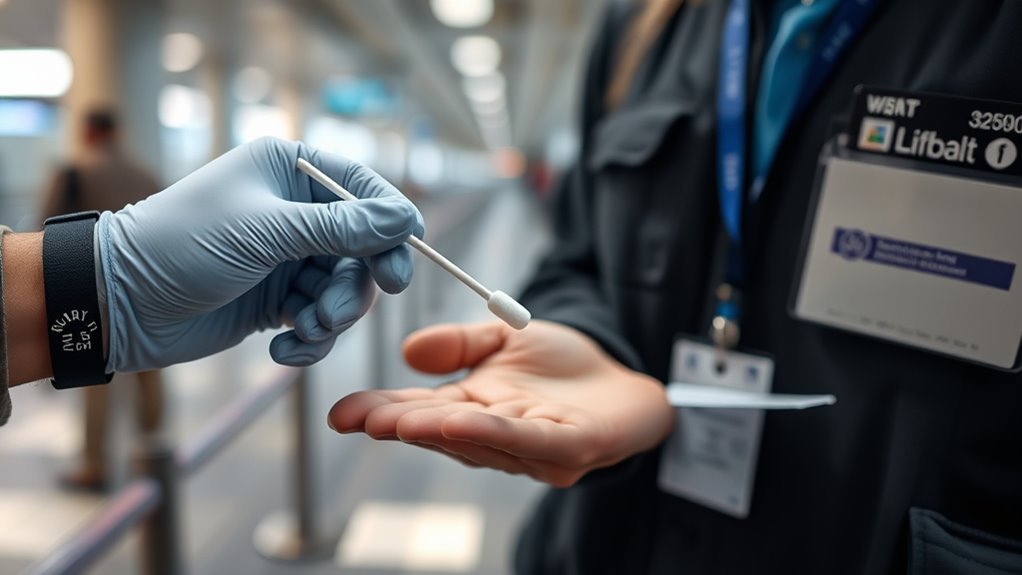
When agents ask to swab your hands, they’re using a quick chemical test to check for trace explosives or other prohibited residues as part of layered airport security measures.
You’ll see hand swabs integrated with identity checks, carry-on inspections, and behavioral observation to reduce risk without causing major delays.
Officers use swabs to confirm alarms from screening equipment or to spot otherwise invisible threats, then analyze samples with portable detectors or lab-based methods.
This approach helps prioritize secondary screening, guide resource allocation, and support broader safety protocols.
You’ll experience this as a brief, noninvasive step that strengthens overall passenger protection.
When Officers Usually Request a Hand Swab
Because officers aim to catch trace residues that machines or behavior screening might miss, they’ll ask to swab your hands during targeted checks—after an alarm from the X-ray or explosives trace portal, following a random check, or when behavioral indicators raise concern.
You’ll be guided calmly, asked to remove items, and given a quick swab that’s noninvasive and sanitary. Officers explain the process and wait for lab confirmation if needed. You can ask questions and refuse, though refusal may delay travel.
Typical moments you might see a request include:
- after clearing carry-on items
- during secondary screening
- when arriving from sensitive flights
Common Scenarios That Trigger Swabs
If you’ve recently handled powders, liquids, or other substances, TSA may swab your hands to check for residues.
You might also be asked for a swab after activities at the airport like bag drops or touching communal kiosks.
And if nearby security alarms or alerts go off, officers can request a hand swab as part of their follow-up.
Recent Contact With Substances
Ever touched a powdery residue or handled someone else’s medication and wondered if TSA might swab your hands? You’ll likely get swabbed when officers suspect recent contact with substances that could pose a security risk or mimic explosives. They’re checking for trace residues from powders, gels, or transferred particles.
Cooperate calmly—swabs are quick. Common everyday situations that trigger checks include:
- Handling loose supplements, powdered food, or cosmetics that leave fine residues
- Borrowing or sorting medications, pills, or blister packs for someone else
- Touching packaging for chemicals, cleaners, or DIY supplies before security screening
Post-Check-In Activities
What do you do after check-in that might draw a TSA swab? You grab food, handle receipts, or touch shared kiosks; these common actions can leave trace residues that prompt an agent to swab your hands.
You might pick up a coffee cup, remove a sticker, or use a pen at a counter. You could also open a locker, handle other travelers’ items, or adjust boarding passes on conveyors.
Agents look for recent contact with potential explosives, residues, or suspicious powders. Cooperate calmly: tell them what you touched and follow instructions to speed the screening process.
Nearby Security Alarms
When a nearby alarm sounds, agents may swab people in the area to quickly rule out recent contact with explosives or suspicious powders. You’ll likely be asked to stay put while officers collect a quick hand swab and check results.
This isn’t accusatory—it’s precautionary and aims to restore safety. You can cooperate calmly, explain recent activities if asked, and expect a brief process before clearance or further steps.
Typical triggers include:
- Someone setting off a metal detector or baggage alarm
- Spilled powder or unknown residue in a public area
- Nearby security sensor alerts or suspicious packages
Why Hands Are Swabbed After X-Ray and Metal Detectors

Although X-ray and metal detectors screen your bags and body for prohibited items, TSA agents also swab hands because those machines can miss trace residues and non-metallic threats. You mightn’t carry a visible weapon, but residue from explosives, narcotics, or chemical agents can cling to skin or surfaces.
Swabbing detects microscopic particles those scanners can’t see, improving threat detection without invasive search. It helps confirm alarms or clear routine screenings quickly.
You’ll usually comply voluntarily; the simple swab speeds processing and keeps checkpoints safer by revealing substances that would otherwise go unnoticed during standard imaging.
What a TSA Hand Swab Involves Step-by-Step
Now that you know why agents check hands after imaging, here’s how a typical swab actually happens: an officer will ask you to extend one or both palms, then they’ll wipe a small, sterile cloth or disposable swab across your skin and sometimes between fingers or along the creases.
Agents may ask you to extend your palms while they gently swab skin and finger creases with a sterile cloth.
The swab goes into a sealed envelope or machine cartridge and is analyzed either on-site by a chemical detector or sent for further testing.
You’ll usually stand still, follow simple instructions, and can ask questions. The process is noninvasive and routine.
- You may be asked to remove gloves.
- Officers explain results protocol.
- You keep personal dignity.
How Long the Swab Process Takes
If you’ve ever worried about added delays, the hand-swab step itself usually takes under a minute: the officer will ask you to extend a palm, swipe a small sterile cloth across your skin and between fingers, seal the swab, and move on.
In practice, the whole interaction—approach, brief instruction, swab, and confirmation—often adds only a few minutes to your screening, especially when lines move smoothly.
Factors like peak travel times, additional probes, or secondary screening can extend your wait, but the swab action is quick.
Stay ready, follow directions, and you’ll be through promptly.
Are Hand Swabs Invasive or Painful?
The swab itself is neither invasive nor painful — an officer simply wipes a small sterile cloth across the surface of your hands and between fingers, which you’ll barely notice after the initial touch. You’ll stand still for a few seconds while they sample areas you naturally expose, and you can expect no contact with sensitive skin or invasive probing. It’s routine, quick, and designed to minimize discomfort and intrusion.
- It feels like a light, damp wipe across your palms and between fingers.
- You won’t need to remove rings unless asked for a clearer sample.
- It’s over in moments, no recovery needed.
What a TSA Hand Swab Can : and Can’t : Detect
A TSA hand swab can pick up trace residues left by touch—like explosive particles, narcotics, or certain chemical markers. It can’t tell intent, identify every substance present, or detect compounds that left no measurable residue.
You should know swabs reveal only what’s physically transferred to your skin and what survives until testing. They’ll flag specific chemical signatures that match the detector’s library, but won’t distinguish quantities reliably or confirm active manufacture.
Environmental contamination, recent handwashing, or degraded residues can produce false negatives. Positive results prompt secondary screening and questions; they’re investigative leads, not definitive proof of wrongdoing or harmlessness.
Typical Explosive Markers and Particles Checked
When your hands are swabbed, officers are looking for trace explosive residues that could link you to prohibited materials.
They’ll check specifically for common nitroglycerin particles as well as signatures of peroxide-based compounds.
This helps them distinguish everyday contaminants from substances that require further screening.
Trace Explosive Residues
Curious what residue swabs are actually looking for? You’ll find they target tiny chemical traces left by explosives, not whole charges. Agents check for molecules and particulates that indicate handling, transfer, or manufacture. You won’t feel it; detectors analyze compounds to flag risks quickly so screenings stay efficient.
- Stabilizers and oxidizers that commonly accompany explosive formulations
- Trace particles from propellants or primer compounds on surfaces
- Molecular signatures detected by swabs and analyzed by lab-grade sensors
These markers help security distinguish innocuous contaminants from genuine threats, keeping screening focused and fast.
Common Nitroglycerin Particles
How do nitroglycerin particles typically appear on swabs, and what makes them reliable markers for explosive residue? You’ll find minute, crystalline or oily nitroglycerin traces that haven’t degraded quickly; they adhere to skin oils and fabric fibers, so swabs pick them up efficiently.
Labs detect characteristic chemical signatures—specific nitrated glycerol fragments—using ion mobility or mass spectrometry, giving high sensitivity and low false positives when protocols are followed.
You should know handlers screen for common byproducts and stabilizers too, since those corroborate nitroglycerin presence. This targeted approach helps security distinguish relevant explosive residues from benign contaminants.
Peroxide-Based Compounds
Why do peroxide-based explosives demand special attention in swab screening? You handle common household chemicals that can form peroxide-based explosives like TATP and HMTD, which leave different chemical traces than nitro compounds. TSA swabs target unstable peroxide residues and related precursors, so you’ll be screened for subtle markers that indicate accidental or deliberate synthesis. Detection helps prevent sensitive, easily detonated materials from getting on aircraft.
- You might unknowingly transfer peroxide trace from contaminated surfaces.
- TSA tests look for organic peroxides and precursors.
- Proper detection reduces risk from shock-sensitive compounds.
How Trace-Detection Machines Identify Explosives
When a TSA officer swabs your hands or belongings, the sample goes into a trace-detection machine that looks for chemical signatures of explosives using ionization and mass analysis.
You’ll see devices that vaporize or desorb particles, then ionize molecules so they carry charge. The instrument separates ions by mass-to-charge ratio, producing a spectrum.
Software compares peaks to known explosive markers like nitroaromatics, nitrate esters, or peroxides, flagging matches above set thresholds. Results display quickly, guiding further screening.
The process detects minute residues you can’t feel, making the system effective at finding trace explosive materials without bulk samples.
Why False Positives Happen and What TSA Does
You’ll see false positives when trace contamination from everyday objects or recent environment contact triggers the swab. The machines’ high sensitivity can pick up minute residues that aren’t a real threat.
TSA follows verification procedures—secondary tests and questioning—to sort harmless traces from genuine risks.
Trace Contamination Sources
Because trace amounts of explosive residues can come from everyday places—like handling cash, using public transit, or touching airport surfaces—TSA swabs sometimes pick up substances that aren’t linked to malicious intent. You should know contamination can be incidental, from shared surfaces, or from items you handled earlier.
TSA follows protocols: they document, rerun tests, and may interview you to rule out risk. You’ll rarely face consequences if contamination is explainable.
To relate, consider common sources you might encounter:
- Public transit poles and ticket machines
- Retail counters and cash handling
- Luggage or clothing previously exposed to crowded areas
Testing Sensitivity Limits
Although TSA’s detection tools are designed to spot minute traces, their extreme sensitivity means swabs can register harmless residues, and that’s why apparent “positives” don’t automatically mean you posed a threat. You’ll learn that background contamination, transfer from objects, or even cleaning products can trigger readings. Instruments prioritize sensitivity to protect everyone, so operators interpret results with context. You shouldn’t panic if a swab flags something; procedures separate likely innocuous traces from real risks. Briefly, think of sensitivity as a wide net: useful for safety, but it catches harmless bits too.
| Cause | Likelihood | Example |
|---|---|---|
| Transfer | Medium | Door handle |
| Residue | Low | Lotion |
| Cross-contact | Medium | Cash |
TSA Verification Procedures
When a swab registers a signal, TSA agents follow layered verification steps so you aren’t wrongly flagged: they’ll retest the area, run confirmatory assays if needed, and consider context like travel history or recent handling of common items.
You’ll usually see calm, quick checks rather than alarm. Agents ask brief questions, compare results to instrument thresholds, and sometimes consult supervisors or lab support before escalating.
False positives often stem from legal substances or cross-contamination. You can help by being honest about recent activities and staying cooperative.
- Expect retesting and short interviews.
- Declare recent handling of powders or chemicals.
- Stay calm; verification limits disruptions.
What Happens After a Positive Swab?
If a TSA swab flags your hands as positive for prohibited residue, agents will take a few procedural steps to verify and document the result. They’ll usually repeat the swab to confirm, note the time and location, and log the finding in their report.
You’ll be asked simple questions about recent activities or items you handled. If contamination persists, officers may inspect your carry-on and may need to interview you further or involve law enforcement for potential criminal or safety concerns.
You can request clarification about procedures and expect documentation; cooperate calmly, answer truthfully, and follow instructions.
Differences Between Passenger Swabs and Baggage Swabs
Besides confirming a positive hand swab, TSA uses different swabbing approaches and protocols for passengers versus baggage, and those differences affect how results are handled and what you can expect.
You’ll notice passenger swabs focus on skin and immediate contact points, done quickly and with visual guidance, while baggage swabs target surfaces, seams, and high-touch items and may be more thorough.
Procedures differ for chain-of-custody, assessment timing, and secondary screening. You can expect clearer communication and immediate follow-up if you’re swabbed personally.
- You’ll be asked to show hands and cooperate.
- Baggage swabs can delay bag claim.
- Different technicians handle each type.
How TSA Records and Stores Swab Results
Although TSA’s swab results feed into several different systems, you’ll usually get a concise record that links the test outcome to a specific screening event, item, or passenger ID. The swab data are logged electronically with time, location, screener ID, and device serial number.
Positive or inconclusive reads trigger flags routed to supervisory consoles and, if needed, nearby inspectors. Records stay tied to the screening manifest and may enter centralized databases for trend analysis, maintenance, or training.
Access is limited to authorized personnel; retention follows agency policy. You can expect audits, but detailed legal discussions belong to the next section.
Your Legal Rights During a Swab
When an officer swabs your hands, you have specific rights that matter: you can ask why the test is being done, request identification for the screener, and state any medical or mobility concerns that might affect the procedure.
You should be treated respectfully, told what’s happening, and given reasonable accommodations if needed. Know that you can ask questions, document the interaction, and seek a supervisor if something feels wrong.
Stay calm, cooperative, and clear about any limitations.
- Ask for ID and an explanation.
- Mention medical issues or disabilities.
- Request a supervisor or note the interaction.
Can You Refuse a TSA Hand Swab? Consequences Explained
You can refuse a TSA hand swab, but doing so has consequences you should know. If you decline, officers may deny screening, require additional screening, or refer you for secondary inspection. You’ll likely face delays, missed flights, or possible denial of entry to the secure area. Refusal can also prompt law enforcement involvement in rare cases.
| Action after refusal | Possible outcome |
|---|---|
| Denied screening | Missed flight/delay |
| Secondary inspection | Longer wait/time loss |
| Law enforcement call | Interview or citation |
| Denied entry | Can’t board/enter secure area |
How Privacy and Dignity Are Protected During Swabbing
When you’re swabbed, TSA officers follow strict professionalism standards to keep the process respectful and consistent.
Procedures are designed to protect your privacy—swabs are done quickly, with minimal exposure and in designated screening areas when possible.
If you have concerns about dignity, you can ask for accommodations or clarification about the procedure.
Officer Professionalism Standards
Although the swabbing process is brief, officers follow strict professionalism standards to protect your privacy and dignity. They explain actions clearly, ask for consent when possible, and position themselves and instruments to minimize exposure. You’ll notice calm, respectful language and measured movements; they treat everyone consistently to avoid embarrassment.
If you have concerns, you can speak up and expect a polite response or supervisor involvement. Officers undergo training on boundary, communication, and cultural sensitivity to guarantee fairness.
- They announce steps before touching you.
- They maintain a neutral tone and pace.
- They avoid unnecessary contact and conversation.
Privacy-Preserving Procedures
Building on those professionalism standards, officers use specific privacy-preserving procedures so your dignity stays intact during swabbing. You’ll be offered a quiet spot or screened area when available, told what will happen, and given the chance to ask questions. Officers keep movements minimal and explain results privately. You can request same-gender staff when possible.
| Setting | Explanation | Options |
|---|---|---|
| Screened area | Short distance from crowds | Yes/No |
| Verbal notice | Clear, brief steps | Ask questions |
| Staff choice | Same-gender request | Documented if denied |
These steps limit exposure and respect your preferences.
Dignity During Screening
How will your dignity be protected during a TSA hand swab? You’ll stay informed and respected: officers explain the process, ask consent when possible, and offer alternatives if you’re uncomfortable.
The swab is quick, noninvasive, and done with clean single-use materials. If you prefer, a same-gender officer or private screening area is available. You can decline a specific screener and request reassignment.
TSA trains staff in respectful communication and privacy protocols to minimize embarrassment and maintain professionalism throughout the interaction.
- You’re told what’ll happen and why.
- You can request privacy or same-gender screening.
- Staff use disposable supplies and clear procedures.
How Procedures Vary by Country and Airport
Because airports follow different security philosophies and legal frameworks, TSA-style hand swabbing can look quite different depending on where you travel. You’ll notice variations in frequency, who conducts the swab, and whether it’s paired with questions or secondary screening. Some places use random selection; others target specific flights or behaviors. Procedures reflect local laws, available technology, and passenger volume, so expect differences in wait times and privacy protections.
| Region | Typical Practice | Passenger Role |
|---|---|---|
| US | Sporadic, officer-led | Comply, ask questions |
| EU | Protocol-driven, legal reviews | Assert rights |
| Asia | High frequency, tech-aided | Follow staff instructions |
How Work, Hobbies, or Travel Patterns Affect Results
If you work with chemicals, pet hair, or a high volume of passengers, your swab results can reflect those exposures rather than any wrongdoing, so it’s important to recognize how daily activities shape what agents show up on screening tests.
You should tell TSA about jobs or recent tasks that involve powders, cleaning agents, animal handling, or frequent close contact with travelers; that context helps officers interpret detections.
Also consider travel patterns—layovers, crowded terminals, or cargo areas raise chances of incidental transfer. Keep documentation or ID badges handy if you need to explain occupational exposure.
- Veterinary or grooming work
- Industrial cleaning or lab tasks
- Frequent business travel
Everyday Items and Substances That Trigger Alerts
When you touch common items—medicines, cosmetics, food powders, or pet dander—those residues can make swabs light up even though you’ve done nothing wrong. Everyday products like hand lotion, sunscreen, and makeup contain compounds similar to trace detection targets.
Household cleaners, baking flour, powdered drink mixes, and even chalky supplements leave particles on your skin. If you handle pets or their bedding, dander and grooming products can register.
Gardening soils, fertilizers, and certain industrial lubricants also interfere. TSA uses follow-up protocols, but knowing which items transfer easily helps you understand why alerts happen despite ordinary daily activities.
How Frequent Flyers Can Reduce Swab Likelihood
If you fly often, you can cut down swab checks by packing light and keeping frequently used items easy to access.
Keep your hands clean and avoid handling powders or strong-smelling substances before security.
Choosing traceable, simple items and showing them quickly when asked will speed you through screening.
Pack Light, Accessible Items
Want to skip the extra hands-on screening? Pack light and keep items accessible so security can verify quickly without lingering. Streamline your carry-on: fewer pockets, visible toiletries, and easy-to-reach electronic devices lower the chance an agent will swab your hands for prolonged inspection. You’ll breeze through queues when officers can confirm contents at a glance.
- Put liquids in a clear, single pouch near the top.
- Store laptops and tablets in an outer sleeve for instant removal.
- Keep small metal items in one small container to avoid searching pockets.
Travel smart: fewer barriers mean faster checks and less handling.
Maintain Clean, Traceable Hands
Curious how you can make your hands less likely to be swabbed? Keep them clean and predictable. Wash with soap and water before heading to the airport and avoid handling unusual powders, sticky residues, or strong-smelling substances.
Use unscented lotion sparingly; heavy fragrances or lotions can attract extra attention. Store toiletries and snacks in sealed bags so residues don’t transfer to your skin.
When you touch public surfaces, sanitize hands afterward with alcohol gel. Consistently clean, minimally contaminated hands create a clear baseline for security sensors, reducing the chance you’ll be selected for additional swabbing at checkpoints.
What TSA Training Looks Like for Trace-Detection Officers
When you step up to the security lane, know that trace-detection officers undergo focused, hands-on training to spot and swab for explosive residues and other prohibited substances. They learn both the science behind trace detection and the practical techniques for consistent sample collection.
You’ll see officers apply taught protocols, handle swabs to avoid contamination, and use instruments that read trace amounts. Training emphasizes safety, chain-of-custody, and customer communication so your screening is swift and respectful.
You can expect professional procedures performed the same way every time.
- Practical swabbing drills
- Instrument operation and calibration
- Scenario-based decision practice
What’s Next for Trace-Detection Technology?
Training gives officers the foundation, but technology will shape how screening looks at airports in the years ahead. You’ll see more sensitive detectors that identify smaller residue amounts faster, reducing delays and false positives.
Expect integrated systems combining swabs, imaging, and machine learning to flag threats with fewer manual steps. Portable, noninvasive sensors could let you pass through checkpoints with minimal interruption while keeping detection rates high.
Privacy-preserving algorithms will focus on substances, not personal data. Over time, automation will let officers concentrate on judgment calls and passenger service, improving both security and throughput.
Myths and Misconceptions About TSA Hand Swabs
Although swabbing might sound invasive or unreliable, most common beliefs about TSA hand swabs are misunderstandings. You shouldn’t assume they’re intrusive searches, collect DNA, or always produce false positives. Agents use simple wipes to check for trace explosives, not to pry into your personal life. You can expect brief, noninvasive contact and professional handling.
- It’s not a search of your body or belongings; it’s a quick surface test.
- It doesn’t collect DNA for identification or criminal databases.
- Positive alerts lead to secondary screening, not immediate accusations.
Trust the process while knowing your rights and staying calm.
How to Document a Disputed Swab or Inspection
If you think a swab or inspection is disputed, take a clear photo of the swab area to capture marks or placement.
Note the exact time, location, and names or badge numbers of any officers involved.
Keep a brief, factual record of what happened while it’s fresh.
Photograph The Swab Area
When you dispute a TSA swab or inspection, photograph the exact area the agent tested so you have an objective record. Take clear, close shots from multiple angles and include context like nearby items or markings. Use your phone’s camera, enable flash if needed, and avoid obstructing evidence. Store images securely and back them up immediately. Don’t alter the scene before photographing.
- Photograph both hands and any specific spots the agent swabbed.
- Include a wider shot showing the surrounding area for context.
- Timestamped photos or metadata help establish when images were taken.
Record Time And Details
After you photograph the swabbed area, note the exact time and specific details of the encounter so you have a clear chronological record.
Record the checkpoint location, lane number, officer names or badge numbers, and any announcements or instructions given.
Write down what you were wearing, items in your hands, and whether you consented or objected.
Include witnesses, their contact info if possible, and nearby camera presence.
Jot down physical sensations or visible residue and the swab container or test strip appearance.
Keep this log on your phone and back it up to cloud storage immediately for later reference or complaint filing.
When to Escalate Concerns or Contact TSA Cares
Although most TSA swabbing issues are routine, you should escalate concerns when the process causes harm, discrimination, or repeated inconsistent treatment. If an agent injures you, denies accommodations, or treats you unfairly, document names, times, and what happened. Contact a supervisor at the checkpoint first; if unresolved, file a complaint with TSA Cares or the TSA Contact Center. Keep copies of records, receipts, and photos.
Expect follow-up but be persistent.
- Note the agent’s name or badge number and describe the incident.
- Save medical records or accommodation paperwork.
- File online or call TSA Cares for assistance and tracking.
Practical Tips to Move Through Screening Faster
Want to get through TSA screening faster? Wear slip-on shoes, minimal jewelry, and easily removable belts. Keep liquids, gels, and electronics accessible in a single bin or clear bag so you can place them in bins without fumbling.
Empty pockets before reaching the conveyor and stow boarding passes and IDs where you can grab them quickly. Follow officer instructions, and if you’re unsure about rules, ask before you reach the line.
Enroll in TSA PreCheck if you travel often to skip removal of shoes and laptops. Stay calm, move promptly when directed, and help others when safe to do so.
Frequently Asked Questions
Do Swabs Test for Biological Agents or Viruses on Hands?
Yes — swabs can detect biological agents or viruses on hands, but they’re mainly used for trace explosives or chemical residues; biological testing needs specific lab analysis, so TSA-style quick swabs aren’t typically used for pathogens.
Can Hand Swab Results Affect Immigration or Customs Screenings?
Yes — they can. If swabs detect prohibited substances or trace explosives linked to illegal items, you’ll face secondary screening, possible detention, fines, or criminal referral; routine passenger swabs rarely trigger immigration or customs penalties.
Are Swab Pads Ever Reused Between Passengers?
No, they don’t reuse swab pads between passengers; TSA agents use a fresh swab for each test and follow protocols to avoid cross-contamination, so you can expect single-use pads or sterile handling during screenings.
Do TSA Hand Swabs Pick up Household Cleaning Residue Like Bleach?
Yes — TSA swabs can pick up household cleaning residue like bleach if it’s present on your hands or surfaces. You’ll likely trigger a chemical response, so avoid strong cleaners before screening to reduce false positives.
Can Minors or Children Be Required to Provide Hand Swabs?
Yes — TSA can ask minors for hand swabs during screening; you’ll cooperate unless legal guardians object, though refusal may lead to secondary screening, delays, or denied boarding, and guardians should assert consent or request alternatives promptly.
Conclusion
TSA hand swabs are a routine, noninvasive part of screening meant to detect explosive residue and keep everyone safe. If you’re asked for one, stay calm, cooperate, and ask questions if you’re unsure. You can document concerns and contact TSA Cares later for complaints or clarification. Knowing what to expect and following simple prep tips—like removing jewelry and keeping hands clean—helps you move through security faster and with less stress.