Can Boxes Be Checked Luggage
Yes — you can usually check a sturdy, well-packed box as luggage if it meets your airline’s size, weight, and content rules. You’ll need durable packaging, sealed seams, clear contact labels, and to declare fragile or restricted items. Oversize or irregular boxes may incur extra fees or be handled as cargo, and international trips add customs paperwork. Check your carrier’s baggage page and arrive early at check-in — keep going and you’ll find practical packing and claim tips.
Short Answer: Can Boxes Be Checked as Baggage?

Short answer: yes, you can usually check boxes as baggage, but conditions and fees vary by airline. You’ll need to verify boxes meet size and weight limits, are securely packed, and have clear labels.
Fragile or irregularly shaped boxes might require special handling or be assessed as oversized, which adds charges. Some carriers treat boxes as checked luggage if they fit standard allowances; others classify them as cargo.
Always check your airline’s policy beforehand, declare valuable or restricted contents, and consider additional insurance. Arrive early so staff can inspect and advise on proper tagging or required reboxing.
When Airlines Typically Accept Boxed Items
When will airlines usually accept boxed items? You can check boxes when they’re properly packed, labeled, and within general checked baggage rules. Airlines accept boxed household goods, gifts, and merchandise if contents aren’t prohibited and boxes can be handled safely. You’ll need secure sealing, sturdy materials, and clear identification. Expect inspections and possible additional handling fees if awkward. Notify the airline in advance for oversized or fragile boxes. Below is a quick checklist comparison:
| Accepted Conditions | What to Do |
|---|---|
| Sturdy packaging | Reinforce corners, use tape |
| Proper labeling | Include name, address, contact |
| Allowed contents | Declare restricted items |
| Fragile items | Mark and notify airline |
Airline Size and Weight Limits for Boxed Baggage
Because airlines set strict size and weight limits for checked items, you should measure and weigh any box before heading to the airport.
Most carriers cap linear dimensions (length + width + height) around 62 inches (158 cm) for standard checked pieces; oversized charges apply beyond that.
Weight limits commonly sit at 50 pounds (23 kg) for economy and 70 pounds (32 kg) for premium or cargo, with excess-baggage fees if you exceed them.
Fragile or irregular boxes may face special handling fees.
Pack to distribute weight evenly, use sturdy materials, and anticipate extra charges if your box is large or heavy.
How to Find Your Airline’s Box Policy

If you want to avoid surprises at the airport, check your airline’s specific box policy before you pack—most carriers publish size, weight, and packaging rules on their websites, along with fees for oversized, overweight, or irregular items.
Start at the carrier’s baggage or help center page, search for “boxes,” “irregular items,” or “checked baggage.” Note measurement methods (length vs. linear inches), allowed materials, and packing recommendations.
Call or chat with customer service if details aren’t clear or policy pages conflict. Save screenshots or email confirmations showing applicable rules and any quoted fees before you travel.
Domestic vs. International Checked-Box Rules
Domestic and international checked-box rules can differ considerably, so you should review both before you travel.
Domestic flights often let you check boxes as standard baggage if dimensions and weight meet limits, but packing, labeling, and handling practices vary by carrier.
For international trips, customs declarations, import restrictions, and differing liability rules matter; you’ll need accurate item descriptions and might face extra inspections or duties.
Some countries ban certain materials or require permits.
Confirm airline and destination regulations, purchase appropriate protection or insurance, and allow extra time at check-in to address documentation or screening that could delay your journey.
Common Prohibited Items in Boxed Luggage
Rules and paperwork only get you so far—what you pack matters just as much. You’ll avoid delays by not packing prohibited items: explosives, flammable liquids, pressurized gas, and certain batteries. Check airline and TSA lists before sealing a box. If you need to transport medical supplies or tools, declare them and follow packaging rules. Below is a quick reminder table to scan before you ship.
| Category | Examples | Action |
|---|---|---|
| Explosives | Fireworks | Don’t pack |
| Flammables | Paint, lighter fuel | Don’t pack |
| Batteries | Loose lithium | Declare/pack per rules |
| Weapons | Guns, ammo | Declare/avoid packing |
How to Choose the Right Box Material
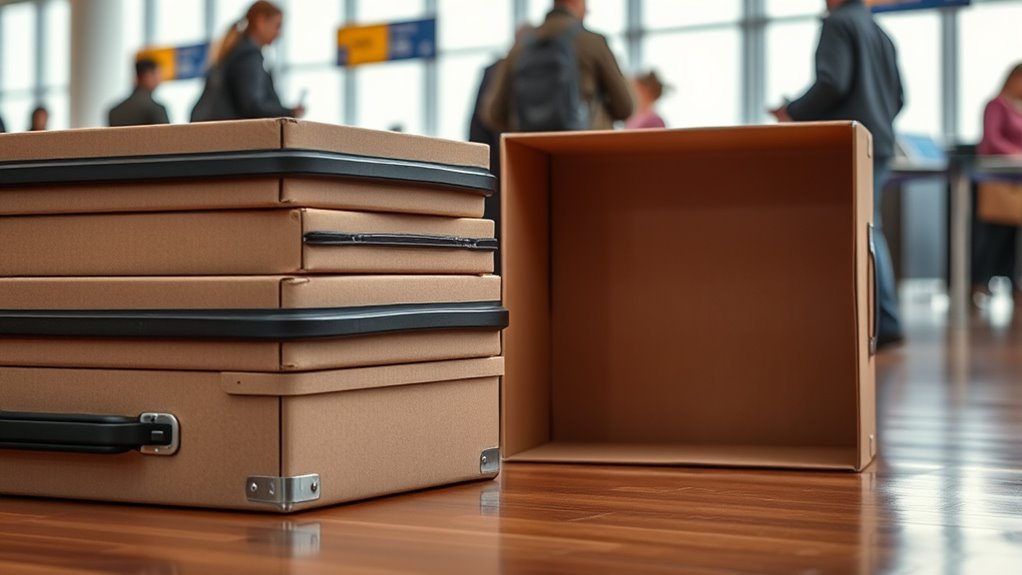
When you’re choosing box material for checked luggage, pick something sturdy enough to withstand drops and rough handling while staying light to avoid excess fees. You’ll weigh durability, moisture resistance, and ease of sealing.
Hard-sided plastics resist impact and water, corrugated cardboard is lightweight and cheap, and plywood offers strength for heavy or irregular loads. Match material to contents and trip length, and reinforce corners and seams.
Consider airline rules on dimensions and fragile labeling. Test closures and add cushioning inside.
Choose materials that balance protection, weight, and cost so your boxed baggage arrives intact.
How to Measure a Box for Checked Baggage
After you’ve picked a material that balances protection and weight, you’ll need to measure the box to make sure it fits airline size limits and avoids surprise oversize fees.
Measure length, width, and height at the box’s longest points including handles and external straps. Use a rigid tape measure and record dimensions in inches or centimeters as the airline specifies.
Add any protrusions like wheels or lids that extend beyond flat faces. For irregular boxes, measure the greatest linear dimensions diagonally if required.
Compare totals to your carrier’s maximum linear dimension to confirm the box qualifies as standard checked baggage.
How to Weigh a Box Accurately
When you weigh a box for checked luggage, pick a scale that’s accurate to at least a half-pound and rated for the box’s expected weight.
Make sure you include the weight of packing materials and tape by weighing the box fully packed, not just the contents.
If your scale is at home and limited, double-check with a postal or luggage scale at the airport to avoid surprises.
Choose The Right Scale
Although you might be tempted to guess a box’s weight, choosing the right scale guarantees you get an accurate reading every time. You’ll want a scale rated for the box’s potential weight, with clear increments and a tare function.
Digital models are faster and more precise; mechanical scales can work but may lack fine resolution. Calibrate periodically and place the box centered on a stable, level surface.
Use batteries or power reliably to avoid drift. Check maximum capacity and readability before purchase so you won’t exceed limits or miss small differences.
- Choose capacity and readability
- Prefer digital with tare
- Calibrate regularly
Include Packaging Weight
If you want an accurate weight, include the packaging—boxes, padding, tape, and any inserts—since carriers charge based on the final packaged mass.
Place the sealed box on your chosen scale and record the total. To find contents-only weight, weigh the empty packaging separately before packing, or subtract a second measurement after removing contents.
Use consistent placement and zero the scale between measurements to avoid error.
For odd shapes, weigh them inside the box as they’ll travel that way.
Note declared weight precisely on shipping forms and double-check carrier limits to prevent surcharges or refusal at drop-off.
How to Reinforce Seams and Corners With Tape
Before you tape anything, clean and dry the corners and seams so the adhesive sticks properly and lasts through transit.
You’ll use strong tape—filament, reinforced cloth, or heavy-duty packing tape—and apply it to stress points. Run tape along each seam, overlapping by at least an inch, then fold tape over raw edges for extra hold.
For corners, create an L-shaped wrap that covers both faces and the tip. Press firmly and smooth bubbles.
Check adhesive after an hour and add another layer if needed.
- Reinforce seams
- Wrap corners
- Press and inspect
Best Internal Cushioning for Fragile Items
You’ll want layered padding—bubble wrap, foam sheets, and crumpled paper—to absorb shocks from different angles.
Place fragile items in individual compartments or wrap them separately so they don’t knock into each other.
Secure those layers with tape or dividers to keep everything from shifting during transit.
Layered Padding Techniques
When packing fragile items, layering different cushioning materials gives you reliable protection against shocks and vibration. You’ll build a simple, effective system: a soft inner wrap, a shock-absorbing middle, and a rigid outer layer.
Place items wrapped in soft materials to prevent scratches, add foam or bubble wrap for impact resistance, then use corrugated inserts or molded boards to distribute force across the box.
- Soft inner: tissue, microfiber, or foam sheets to cradle surfaces.
- Middle shock layer: bubble wrap, convoluted foam, or air cushions.
- Rigid outer layer: corrugated panels or plastic stiffeners to spread loads.
Secure Item Separation
How will you keep fragile pieces from colliding inside a box? You’ll create snug compartments, use soft barriers, and secure items so they don’t shift. Wrap each piece individually, pack heavier items low, and avoid empty spaces that allow movement. Consider molded inserts or cardboard dividers for consistent separation. Test by gently shaking the box; if things move, add padding.
| Method | Benefit |
|---|---|
| Bubble wrap | Cushioning |
| Foam inserts | Custom fit |
| Cardboard dividers | Stable separation |
| Tissue wrap | Surface protection |
| Packing peanuts | Void fill |
These steps minimize impact and protect delicate contents.
How to Stabilize Oddly Shaped Items Inside a Box
Because oddly shaped items can shift and damage themselves or other contents, you’ll want to immobilize them before sealing the box. Start by measuring cavity space and filling gaps so the item sits snugly. Use cushioning that won’t compress completely during handling to maintain support.
- Wrap irregular parts in bubble wrap or foam sleeves, securing with tape.
- Fill voids with crumpled kraft paper, packing peanuts, or inflatable air pillows to prevent movement.
- Create internal braces from corrugated inserts or foam blocks, wedging them so the object doesn’t touch walls.
Check stability by gently shaking the box before sealing.
When and How to Double-Box Valuables
If your valuables could be crushed, scratched, or pilfered during transit, double-boxing adds a layer of protection and deterrence.
You should double-box when items are fragile, valuable, or have irregular shapes that might stress a single box.
Use a sturdy inner box or rigid case wrapped in bubble or foam, then place it inside a larger corrugated outer box with at least two inches of cushioning on all sides.
Fill gaps with packing peanuts or crumpled paper to prevent movement.
Seal both boxes with strong tape and reinforce seams.
Keep weight balanced so handling won’t collapse the inner package.
Labeling and Marking a Checked Box Clearly
When you check a box, use durable, weatherproof labels so information stays readable through handling and rain.
Include your name, phone number, and itinerary inside and outside the box so staff can contact you if it’s separated.
Clearly mark “FRAGILE” and orientation arrows to help handlers keep contents safe.
Use Durable, Weatherproof Labels
Although checked boxes can take a beating on the tarmac, you can keep them identifiable by using durable, weatherproof labels that resist tearing, smudging, and rain. Choose vinyl or polyester labels with strong adhesive; they stay put through handling. Use a permanent, fade-resistant marker or printed labels with laminated coating to prevent ink washout.
Place labels on multiple faces and cover seams so they remain legible if scratched.
- Buy industrial-grade, weatherproof label stock.
- Print high-contrast text and barcodes; laminate if possible.
- Affix labels firmly, smoothing edges to avoid peel.
Include Clear Contact Information
1 clear, complete contact label can save you hours and headaches if an airline misroutes your checked box. You should include your full name, phone number (with country code), and destination address in bold print and waterproof ink. Add a secondary contact—someone local at your destination—and an email. Place one label on top and another inside the box on a card. Make info readable from a few feet away.
| Name | Phone | |
|---|---|---|
| Your Name | +1-555-123-4567 | you@example.com |
| Secondary | +1-555-765-4321 | friend@example.com |
Mark Fragile And Orientation
After you’ve added clear contact labels, turn your attention to marking how the box should be handled: bold “FRAGILE” stickers and arrows showing upright orientation give handlers immediate, practical guidance. You’ll place labels on multiple faces so they’re visible from any angle. Use waterproof, high-contrast stickers and reinforce corners to prevent tears. Include handling notes if contents are delicate, and avoid ambiguous terms.
- Label placement: top and two sides for visibility.
- Sticker type: bold, waterproof, tear-resistant materials.
- Handling notes: concise instructions like “This side up” or “Glass — handle gently.”
These steps reduce damage risk.
How to Declare Fragile or Valuable Contents at Check-In
When you check in, tell the agent right away if your checked bag contains fragile or valuable items so they can note it in the system and advise on packing or alternative options. You’ll get guidance on labeling, cushioning, and whether to carry items aboard. Ask about declared-value limits and required forms. Keep receipts and ID inside the box. Photograph contents and packing before handing the bag over. Request a fragile sticker and confirmation on your boarding pass record. Use insurance if needed and get a claim contact. Stay calm and clear when describing specific items and risks.
| Step | Action | Tip |
|---|---|---|
| 1 | Notify agent | Show receipts |
| 2 | Document | Photo contents |
| 3 | Request label | Ask about limits |
Oversize and Irregular Baggage Fees to Expect
When you’re checking a box, airlines will compare its dimensions and weight to their size and weight limits. Anything over can trigger fees.
You should also expect extra handling charges for oddly shaped or heavy boxes that need special processing.
Check your carrier’s specific limits and rates before you arrive so you won’t be surprised at the counter.
Size And Weight Limits
Because airlines set strict size and weight rules, you’ll face extra charges if your box exceeds their limits—typically measured by linear dimensions (length + width + height) or by weight per bag. You should check carrier policies before packing, weigh and measure your box, and repack to meet limits. Exemptions are rare; oversized or overweight boxes usually incur fixed fees or percentage surcharges.
- Measure: calculate linear inches or centimeters; compare with airline thresholds.
- Weigh: use a reliable scale; watch for common 50 lb/23 kg limits.
- Plan: consolidate, redistribute, or ship ground if you exceed allowances.
Extra Handling Charges
Wondering what extra fees you might face for oversized or oddly shaped boxes? You’ll often pay oversize or irregular-baggage charges if dimensions or weight exceed airline limits. Expect per-item fees, surprise surcharges for fragile handling, and occasional special-equipment costs. Check your carrier; fees and thresholds vary.
| Fee type | Typical impact |
|---|---|
| Oversize | Higher flat fee, anxiety about cost |
| Overweight | Per-kilogram/pound charges, wallet pinch |
| Irregular shape | Handling fee, fragile worry |
| Special handling | Extra charge, relief knowing it’s protected |
Call ahead, measure carefully, and pack to avoid emotional and financial stress.
How Airports Handle Irregular-Shaped Checked Items
If you’re checking an odd-shaped item—like a surfboard, musical instrument, or bulky sporting gear—airports treat it differently from standard suitcases, and you’ll need to plan ahead. You’ll declare oversized pieces at check-in, pay any special handling fees, and follow airline-specific packing and size rules.
Staff often tag items as oversized, route them separately, and load them into cargo compartments or special racks.
You should arrive early, bring protective cases, and verify dimensions and weight limits with your carrier to avoid surprises.
- Measure accurately
- Confirm fees and rules
- Pack for protection
Commonly Boxed but Restricted or Banned Items
Odd-shaped items often get special handling, but some things you’d box up at home won’t make it on a plane at all. You can’t check hazardous goods like aerosols, flammable liquids, or pressurized containers. Perishable items may be restricted. Firearms need declaration and proper cases. Check airline rules before packing.
| Item type | Example | Status |
|---|---|---|
| Flammables | Paint, lighter fluid | Banned or special |
| Aerosols | Spray cans | Restricted |
| Chemicals | Bleach, pesticides | Banned |
| Perishables | Raw seafood | Restricted |
| Weapons | Firearms | Declared/secured |
Transporting Electronics and Batteries in Boxes
How should you pack electronics and batteries in checked boxes to keep them safe and compliant? You’ll need to follow airline and TSA rules: protect devices, isolate batteries, and declare restricted items when required.
Pack electronics in sturdy boxes with cushioning to prevent movement. Remove or secure batteries to avoid short circuits; keep spare lithium batteries in carry‑on when possible.
Pack electronics in sturdy, cushioned boxes; remove or secure batteries and keep spare lithium cells in carry‑on when possible.
Check airline policies for permitted battery sizes and labeling. Declare large batteries or equipment with embedded cells.
Inspect boxes for damage and lock them only with TSA‑approved locks so inspections won’t break your packing.
- Use padding and anti‑static wrap
- Isolate and protect batteries
- Declare oversized batteries
Packing Artwork and Antiques for Airline Travel
When you ship artwork or antiques in checked boxes, treat each piece as fragile cargo and plan packing around its specific materials and weaknesses. Wrap paintings in glassine, foam, or bubble wrap, keeping frames protected and corners reinforced.
Cushion ceramics and sculptures with layered padding and immobilize them to prevent shifting. Use acid-free tissue for textiles and paper, and avoid direct adhesive on surfaces.
Select a rigid, properly sized box and double-box when possible. Label boxes “Fragile” and include contact information.
Consider insurance, photograph items before shipping, and check airline policies for declared value and any special handling options.
Sporting Equipment vs. Boxed Gear: Handling Differences
When you pack sporting equipment, airlines often have specific size, weight, and item rules that differ from standard boxed gear.
You’ll need sturdier packaging for boxed items to protect contents and to meet carriers’ handling requirements.
Also check for extra handling fees or oversize charges so you’re not surprised at the gate.
Sporting Equipment Rules
Ever wondered why airlines treat a surfboard or golf clubs differently from a boxed bicycle? You need to know rules: size, declared status, and fees affect handling.
Sporting equipment often counts as oversized or special items, so you’ll pay extra and follow carrier-specific packing and notification requirements. You’ll also face limits on liability and required protective coverings.
If you declare fragile or oversized gear, staff may route it differently than standard checked bags.
Check your airline’s policy before travel to avoid surprises and ensure your equipment is accepted and handled appropriately.
- Size and weight limits
- Declaration and charges
- Liability constraints
Boxed Gear Packaging
You already know airlines treat sporting equipment differently by size, declared status, and liability; boxed gear adds another layer because its packaging changes how staff handle and classify the item. You should label boxes clearly, reinforce contents, and note fragile areas so handlers see purpose-built containers rather than miscellaneous cartons. Proper packaging can prevent misrouting and reduce damage risk, but it may shift responsibility to you if unusual wrapping hides hazards or bypasses normal gear tags.
| Box Type | Visibility | Handling Cue |
|---|---|---|
| Hard case | High | Fragile |
| Cardboard | Medium | Inspect |
| Custom crate | High | Special |
Handling And Fees
How will handling and fees differ between sporting equipment and boxed gear? You’ll find airlines treat oversized, oddly shaped sporting items—like skis or bikes—as special equipment, often requiring advance notice and higher fees.
Boxes that meet standard dimensions usually go through regular baggage handling with standard fees, but size and weight surcharges still apply.
- Sporting equipment: handled as special items; possible oversized charges and separate check-in.
- Boxed gear: treated as regular checked luggage if within limits; pay standard or overweight fees.
- Prep and communication: call ahead, label clearly, and weigh to avoid surprises.
How to Insure a Boxed Item for Checked Travel
If you’re planning to check a boxed item, start by documenting its condition and value with photos and a dated receipt so you can prove loss or damage later. Next, declare fragile contents at check-in and ask about carrier liability limits. Pack with cushioning, seal seams, and attach a visible inventory list inside. Consider registering serial numbers and backing up receipts electronically. Keep contact info and claim forms handy; file promptly if damage occurs. Here’s a quick checklist:
| Item | Action | Proof |
|---|---|---|
| Photos | Take multiple angles | Timestamped files |
| Receipt | Keep originals | Digital backup |
| Claim | File ASAP | Reference number |
Airline Baggage Insurance vs. Third-Party Options
After documenting your boxed item’s condition and value, weigh the protections airlines include against what third-party insurers offer. Airlines typically cover limited liability per piece, require proofs, and have claim windows; you’ll face caps and exclusions.
After documenting condition and value, compare airlines’ limited liability, caps, and proof requirements with third-party insurance.
Third-party policies often provide higher limits, broader perils, and quicker payouts, but they add cost and may demand separate appraisals.
- Coverage limits: compare per-item caps, deductibles, and aggregate limits.
- Claim process: check required documentation, timelines, and dispute resolution.
- Exclusions & endorsements: watch for fragile, high-value, and new-for-old clauses that affect actual protection.
Alternatives to Checking a Box: When to Ship Instead
When you’re weighing whether to check a boxed item, consider shipping instead when the item is high value, fragile, time-sensitive, or needs tracking and insurance beyond the airline’s limits. You’ll want guaranteed tracking, better insurance options, and specialized packaging services. Use courier services for fragile electronics, antiques, or urgent deliveries. Compare costs, delivery windows, and declared-value coverage. Pack to carrier specs, label clearly, and get proof of pickup. If you need door-to-door service or handling documentation, shipping usually beats checked baggage.
| Reason | Shipping advantage |
|---|---|
| Value | Higher declared coverage |
| Fragility | Specialized packing |
When Shipping Is Safer or Cheaper Than Checking
Why choose shipping over checking your box? You’ll pick shipping when cost, security, or timing make more sense than airline baggage.
Shipping can be cheaper for heavy, nonstandard boxes, avoid oversized fees, and let you compare carriers for best rates.
It’s safer when you need tracking, insurance, or door-to-door handling to reduce lost-or-damaged risk.
You’ll also ship if you need guaranteed delivery windows or can’t lug the box through airports.
- Cost: compare carrier quotes vs. airline fees.
- Security: declared value, tracking, and signature options.
- Timing: scheduled pickup, transit guarantees, and flexibility.
Best Couriers for Fragile Boxed Items
If you’re sending fragile boxed items, pick a courier known for careful handling, reliable tracking, and strong insurance options so your shipment gets the attention it needs from pickup to delivery.
Research carriers with specialized fragile-item services, like extra cushioning, priority handling, and dedicated claims teams.
Compare transit times, tracking granularity, and declared-value limits.
Look for strong customer reviews about breakage claims and responsive support.
Consider door-to-door pickup and white-glove options if items are high value.
Ask about packaging requirements and whether the courier offers packing services.
Choose the carrier whose policies and reputation match your risk tolerance and budget.
Packing Boxes for International Customs and Inspections
You’ve picked the right courier and guaranteed fragile items are well packed, now focus on preparing boxes to clear international customs and inspections. You’ll need clear documentation, honest declarations, and accessible packaging so officers can verify contents without damaging goods.
Label boxes with sender, recipient, and detailed item descriptions. Keep copies of invoices, permits, and any required certificates inside and attached in a weatherproof pouch.
Declare restricted items and follow destination rules to avoid fines or delays.
- Itemized invoice and harmonized codes
- Permits/certificates in pouch
- External labels plus internal packing list
Security Screening: What to Expect for Boxed Luggage
Curious what happens when boxed luggage hits security? You’ll hand your box to airline staff, who tag and route it to screening. Expect X-ray inspection; dense or unclear images may trigger manual checks.
Security officers may open boxes if contents require inspection, so pack items neatly for quick viewing. Prohibited items will be removed and you’ll be notified.
If explosive trace or suspicious issues arise, you might be present during a more thorough search or asked questions. Keep contact information inside and outside the box.
Follow airline and TSA rules to minimize delays and reduce the chance of intrusive inspections.
How to Document a Box’s Condition Before Checking
Before you check a box, take clear timestamped photos from all sides so you have proof of its pre-flight condition.
Note any dents, tears, or scuffs in writing and record the box’s dimensions and weight.
That documentation makes it easier to file a claim if the carrier damages your package.
Take Timestamped Photos
If you want reliable proof of a box’s pre-flight condition, take clear, timestamped photos from multiple angles—front, back, sides, top, bottom, and any labels or existing damage—so you can compare them to how the carrier returns the box.
Use a smartphone or camera with visible timestamps, shoot in good light, and include a ruler or coin for scale.
Store images in cloud backup and a dated folder on your device so they’re easy to retrieve. When filing claims, submit originals plus uploads.
- Capture multiple angles with scale
- Verify timestamps and backups
- Organize files by date
Note Existing Damage
When you’re preparing a box for checked luggage, carefully note any existing damage—dents, creases, scuffs, tears, watermarks, or loose seams—and record their locations and size so there’s no question later.
Walk around the box and inspect each face, edge, and corner. Jot concise notes: “front lower-left dent, 2 cm,” “top seam frayed, 4 cm.” If contents shift or bulge, note that too.
Use clear labels or a short checklist you keep with photos. Keep your documentation accessible at check-in and when filing a claim, so you can prove the box’s preexisting condition.
Record Dimensions And Weight
Want precise proof of your box’s condition? Measure length, width, height with a tape measure and note values in centimeters and inches. Weigh the packed box on a reliable scale, record the unit, and photograph the scale readout. Timestamp everything and save photos with filenames matching your notes.
- Record dimensions: L × W × H in cm and in.
- Record weight: packed weight, unit, and scale photo.
- Timestamp and archive: date, time, photos, and a short written note.
You’ll have clear, verifiable evidence if an airline questions damage or weight charges.
Steps to Take If Boxed Baggage Is Damaged or Lost
Because boxed baggage is treated like checked luggage, you’ll need to act quickly at the airport: report damage or loss to the airline’s baggage service office before leaving the terminal, get a written irregularity report (PIR), and keep copies of your boarding pass and any receipts for packed items. Then document damage with photos, note timestamps, and ask about interim repairs or replacement options. File claims promptly online if required, track claim numbers, and follow up by email. Use the table below for quick steps.
| Step | Who | Deadline |
|---|---|---|
| Report | You | At airport |
| Document | You | Immediately |
| Claim | Airline | Per policy |
Major Carriers’ Boxed-Baggage Rules (Summary)
When you check a box, you’ll need to follow each airline’s size and shape limits so it won’t be rejected or hit oversize fees.
Expect different fee schedules and special-handling options depending on carrier and whether the box is fragile or unusually shaped.
Below we’ll compare what major airlines typically allow and charge so you can pick the best option.
Airline Size And Shape Limits
Although airlines generally treat boxes as checked baggage if they meet size and weight limits, each carrier sets its own rules about maximum dimensions, allowed shapes, and fee structures. You should check linear dimensions (length+width+height) limits, since oversized boxes can be refused or rerouted.
You’ll also watch for irregular shapes—protrusions, loose flaps, or non-rectangular forms—that may require special handling or be disallowed. Measure carefully and compare to the carrier’s published limits before you travel.
- Measure linear dimensions and compare to carrier maximums.
- Confirm allowed shapes and packaging standards.
- Verify gate-check or cargo alternatives for odd sizes.
Fees And Special Handling
Curious how much you’ll pay to check a box? You’ll usually face standard checked-bag fees for size/weight, often $30–$60 domestically, with oversize/overweight surcharges up to $200.
Some carriers treat boxes as special items requiring palletizing or cargo service, which raises costs and adds paperwork. Fragile or high-value contents may need declared value, extra handling fees, or mandatory crating.
Military, senior, or loyalty exemptions occasionally apply. Always check the carrier’s boxed-baggage rules before travel, measure and weigh precisely, and call ahead if you expect special handling to avoid surprise charges at the counter.
Airport Check-In Tips to Reduce Handling Damage
Want to cut down on the chance your checked box gets banged up? At check-in, you’ll want to be proactive and strategic so handlers treat your box like luggage, not trash. Ask agents about size limits and fragile tagging; request gate check if available for short flights. Make sure labels are secure and include your contact info inside and out. Consider lightweight reinforcement at corners and use tape to seal seams.
- Choose a sturdy outer box and pad contents well.
- Clearly mark FRAGILE and orientation arrows.
- Weigh and measure to avoid forced repacking.
How Frequent Travelers Pack Boxes Efficiently
When you travel often with boxed items, pack with a checklist mindset: choose a box that’s just large enough to fit your items plus cushioning, group fragile things together, and use consistent padding and corner protection so you can pack faster each time. You’ll label contents, record weights, and pre-measure airline size limits. Stack heavier items at the bottom, fill voids to prevent shifting, and seal seams robustly. Reuse the same box sizes to streamline replacements and carry-on adapters. Review past damage notes to refine layout and cushioning choices for each trip.
| Step | Benefit |
|---|---|
| Standardize | Faster prep |
| Inspect | Fewer surprises |
| Record | Repeatable success |
Eco-Friendly Packing Materials for Boxed Baggage
When you pack boxes for checking, choose reusable packing wraps to cut single-use waste and keep items secure.
Pair those with biodegradable cushioning materials like corrugated inserts or cornstarch peanuts to protect fragile goods without harming the environment. These swaps make your boxed baggage greener and usually just as reliable.
Reusable Packing Wraps
- Washability preserves hygiene and reusability.
- Compressibility saves box volume and weight.
- Versatility replaces multiple single-use products on trips.
Biodegradable Cushioning Materials
Although you still want reliable protection for fragile items, biodegradable cushioning materials give you that security without the landfill guilt. You can choose molded pulp inserts, corrugated paper pads, or starch-based packing peanuts that cushion impacts and compress to save space.
These options break down naturally, so you won’t stash foam in trash for decades. They’re lightweight, often compostable, and accepted by most airlines since they don’t look like food or hazardous matter.
Pack snugly to prevent shifting, label the box if compostable residue might concern handlers, and combine materials to balance protection and sustainability.
Ready-to-Check Checklist for Boxed Items
Before you head to the airport, make a quick checklist to confirm your boxed items meet airline rules and travel needs. You’ll want to verify size and weight limits, secure fragile contents, and label the box clearly. Follow carrier rules to avoid fees or denied check-in. Use sturdy tape and tamper-evident seals, and cushion items with biodegradable padding if allowed. Keep receipts and documentation for valuable contents.
Before heading to the airport, confirm size/weight, secure and label boxes, photograph contents, and keep receipts.
At drop-off, inspect handling policies and ask staff about special tags. Finally, photograph the packed box and its labels so you’ve proof if damage or loss occurs.
- Verify dimensions and weight
- Protect and seal contents
- Photo and documentation
Frequently Asked Questions
Can I Check a Box Containing Perishable Food Items?
Yes — you can check a box with perishable food, but you’ll need to pack it properly with ice packs or dry ice per airline rules, label it, declare contents if required, and expect potential inspection or refusal.
Are There Airline Rules About Checking Boxes With Liquid-Filled Containers?
Yes — airlines generally restrict checked liquids: you’ll need to secure containers, prevent leaks, and follow hazardous-material rules; large quantities or certain liquids (like alcohol above specific ABV) may be prohibited, so check your carrier’s policies first.
Will Checked Boxes With Sharp Tools Require Special Packing or Declaration?
Yes — you’ll need to pack sharp tools safely (sheath, wrap, or rigid case) and follow airline rules; declare them if requested, and expect security inspection or restrictions on certain knives, blades, or dangerous tools.
Can I Check a Box That Contains Medications and Medical Devices?
Yes, you can check a box with medications and medical devices, but you’ll need prescriptions or documentation, pack items securely, declare liquids or batteries, and follow airline and TSA rules to avoid delays or confiscation.
Do Checked Boxes With Cultural Artifacts Require Export Permits?
Yes — you’ll often need export permits for checked boxes containing cultural artifacts; regulations vary by country, so you’ll check local heritage and customs laws, declare the items, and secure documentation before shipping or traveling internationally.
Conclusion
Yes—you can usually check boxes as baggage, but airlines impose size, weight, and material rules. Measure and weigh your box, check your carrier’s policy, and reinforce corners with tape and cushioning. Remove loose items, label it inside and out, and be ready to pay oversize or extra fees. For fragile contents, consider hard-sided cases or shipping services. With proper packing and planning, checking a box is simple and often cost-effective.